
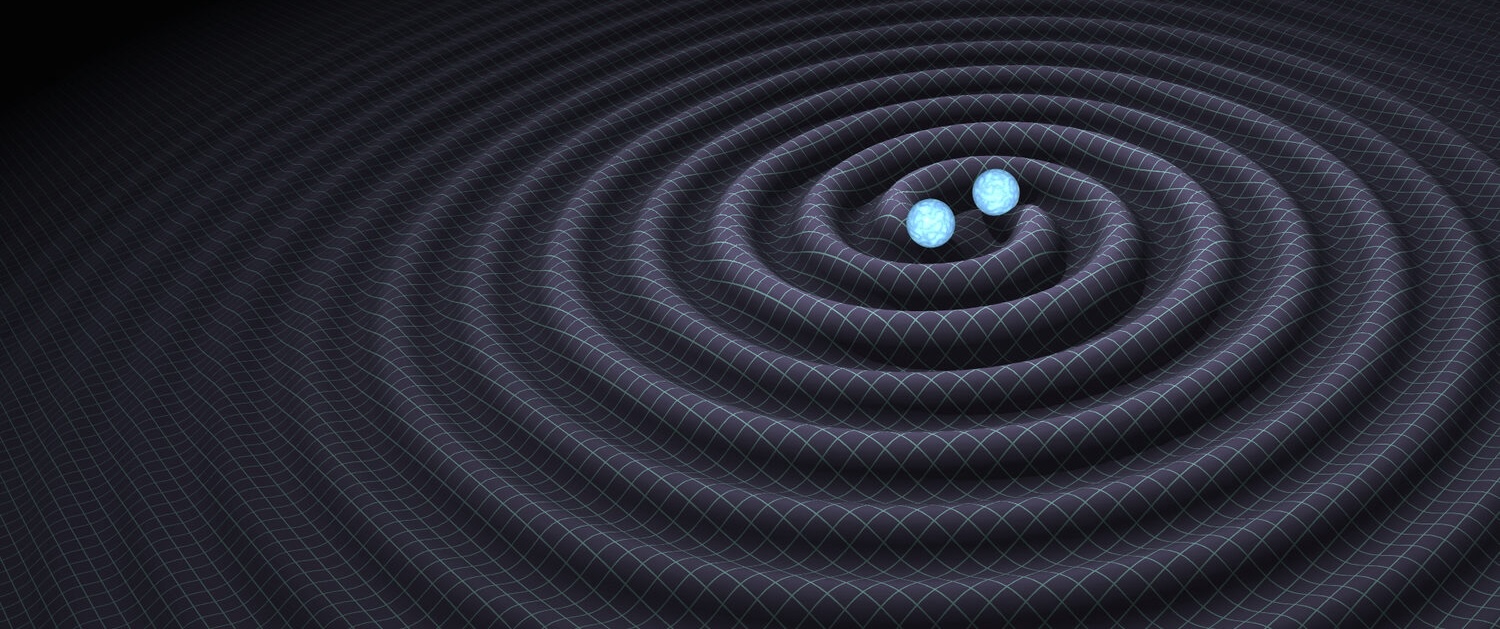
The LIGO Virgo and KAGRA (LVK) Collaborations have conducted a new search for the incredibly faint continuous gravitational waves (CWs) emitted by Neutron Stars (NSs), the extremely dense, spinning cores left behind after massive stars undergo a supernova explosion. Using data from the first and second parts of the fourth observing run (O4a: May 2023-January 2024, and O4b: April 2024-January 2025) of the LIGO, Virgo and KAGRA interferometers, this search marks another milestone in the effort to detect gravitational waves not from violent cosmic collisions, but from stable astrophysical sources. These delicate, periodic signals could open a window into the hidden interiors of NSs, the most compact objects in the cosmos after black holes. Despite numerous efforts (see our last search here), these signals remain surprisingly undetected, indicating how close NSs are to a perfect sphere.
Which objects emit CWs, and why are they interesting for us?
NSs are dense, very compact objects with a mass larger than our Sun compressed into a radius of roughly 10 km. The extreme density brings into play quantum phenomena that determine the structure of these extraordinary objects. Unlike normal stars, they are believed to be extremely stiff and to have a layered structure (see Figure 1). They are surrounded by a very thin atmosphere, with an outer crust and an internal core, where the properties of matter become more and more exotic approaching the center of the star. Some NSs rotate hundreds of times per second, and if their mass distribution is even slightly asymmetric, this imperfection can cause them to emit faint, periodic CWs which have not yet been detected.
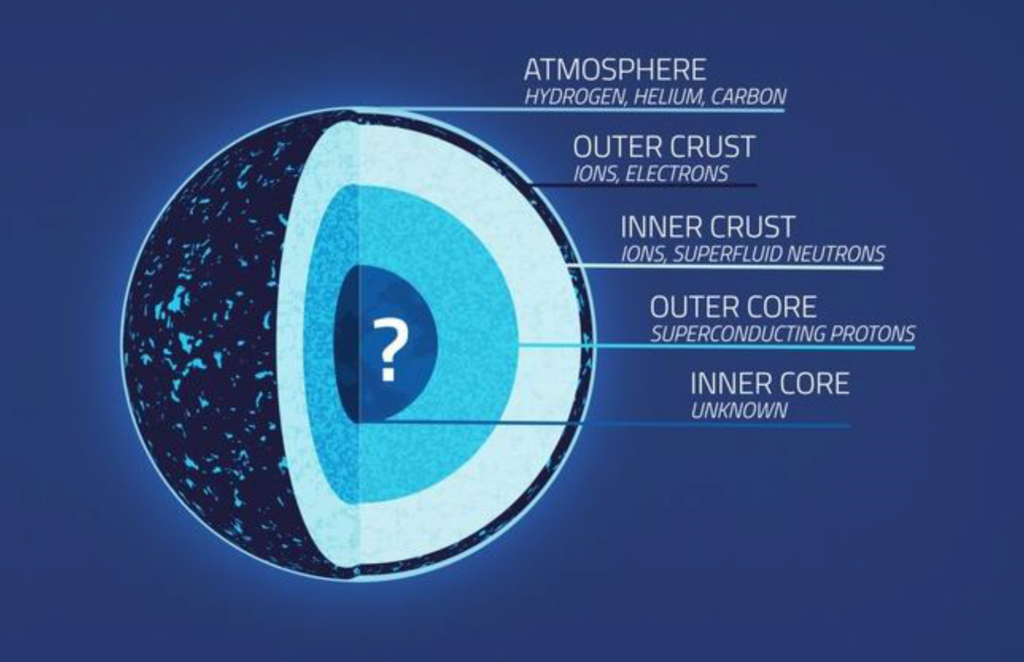
Figure 1. Sketch of a NS’s layered interior structure. Credit: NASA GSFC. (See also this review article.)
NSs possess extremely strong magnetic fields, ranging from one hundred million to one quadrillion times stronger than Earth’s magnetic field, that generate beams of electromagnetic radiation (see Figure 2) across a wide range of frequencies, from radio waves to X-rays and gamma rays.
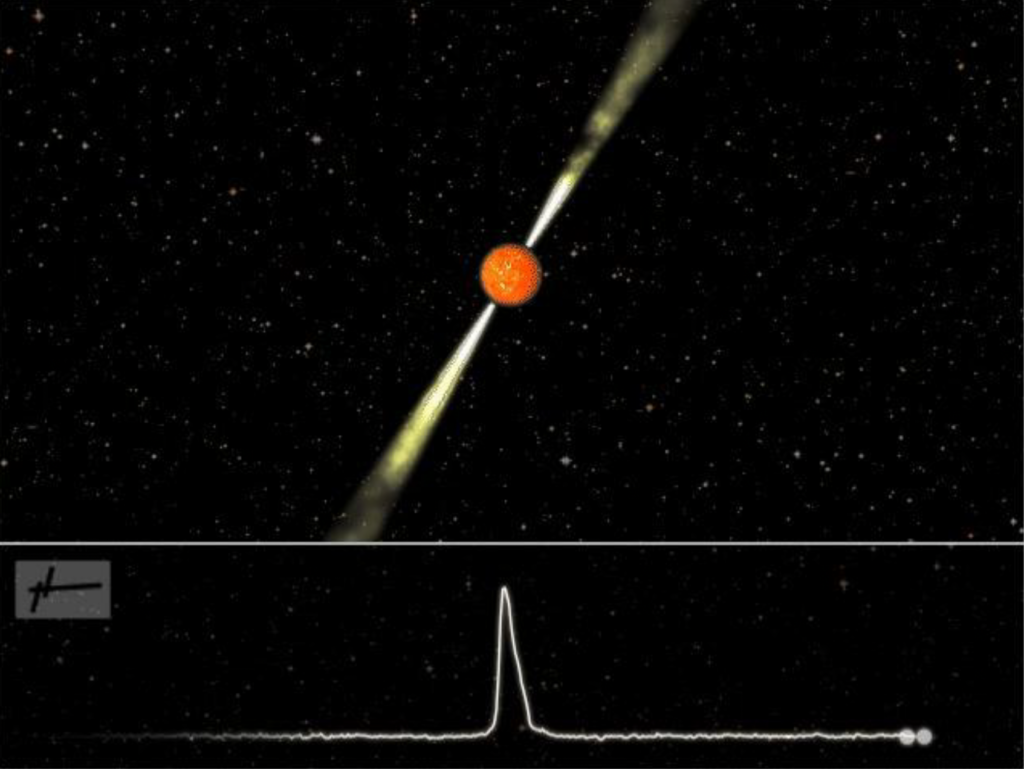
Figure 2. Impression of a pulsar showing the rotating neutron star, together with the emitted beams of electromagnetic radiation, highlighting the regular arrival of pulses at a telescope. Image credit: Joeri van Leeuwen, License: CC-BY-AS.
As the star rotates, these beams sweep through space like a cosmic lighthouse, producing regular pulses every time they cross our line of sight on Earth. Observations of pulsars across multiple electromagnetic (EM) observatories provide us with precise measurements of the pulsars’ positions in the sky, their rotational frequency, and how the parameters that describe their behavior are evolving with time (known as the “spin-down”). From these EM observations, we are also able to understand and describe the orbital motion of the pulsar if it happens to be in a binary system. This detailed knowledge makes pulsars ideal targets for CW searches, as it allows scientists to concentrate on the specific frequency ranges where such signals are expected.
Unveiling these signals would mark a major breakthrough, enabling scientists to probe the internal structure of NSs and uncover new insights into matter under extreme conditions.
In this study, we focused on 39 known pulsars (see Figure 3), trying to catch their faint, CW emissions.
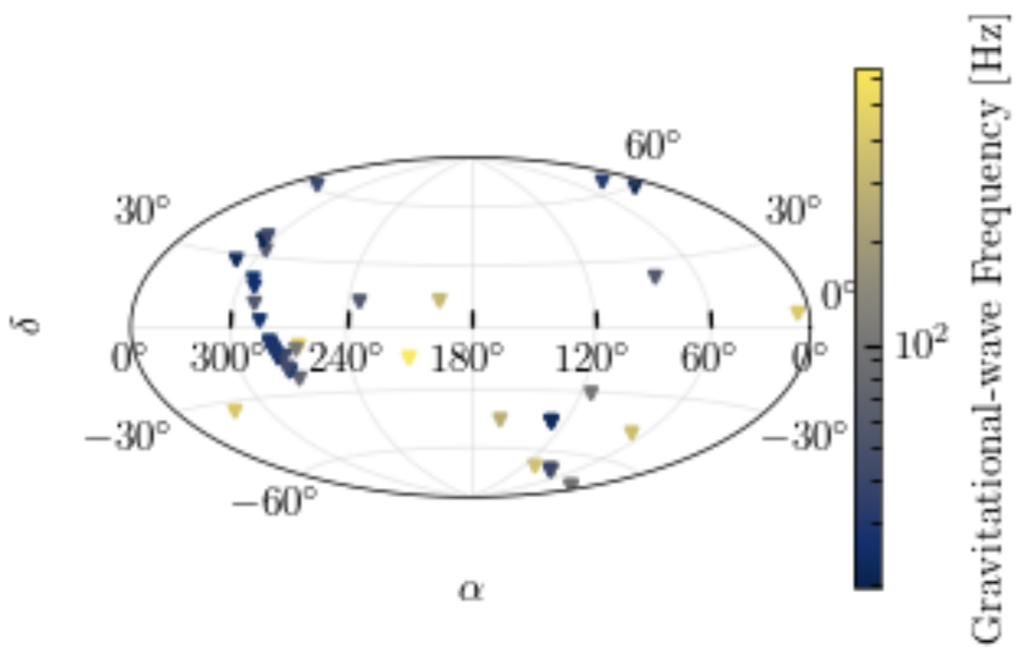
Figure 3. (Fig. 1 from our article) Sky location in equatorial coordinates of the analyzed targets.
How do we search for a CW signal?
Generally, we have to adapt our search method to the emission mechanism we consider, or to the accuracy with which we know the CW parameters. Here, we applied a so-called narrowband search, capable of exploring a small frequency band and tailored to account for potential mismatches between the EM and CW emissions. In fact, some models predict that the NS outer crust (see Figure 1), which is the dominant source of the EM emission, might be lagging behind the core, rotating at a slightly different velocity. In this scenario, with narrowband searches, we look for deformations of the core induced by the powerful magnetic field in the interior of the neutron star.
It could also happen that noisy EM data do not allow us to adequately constrain the frequency evolution of the pulsar emission over time. Consequently, these effects reduce our detection chances if not properly accounted for.
What have we found?
Unfortunately, we did not report any detection from our targets using O4ab data taken by the LIGO Hanford and LIGO Livingston observatories.
The deformations of these neutron stars are quantified by a parameter called “ellipticity”, and the non-detection of CWs in O4ab means that their ellipticities must be lower than threshold values called upper limits (see Figure 4). In other words, scientists now have more precise estimates of the maximum possible distortions these pulsars could have, even if those deformations were too small to generate a detectable signal.
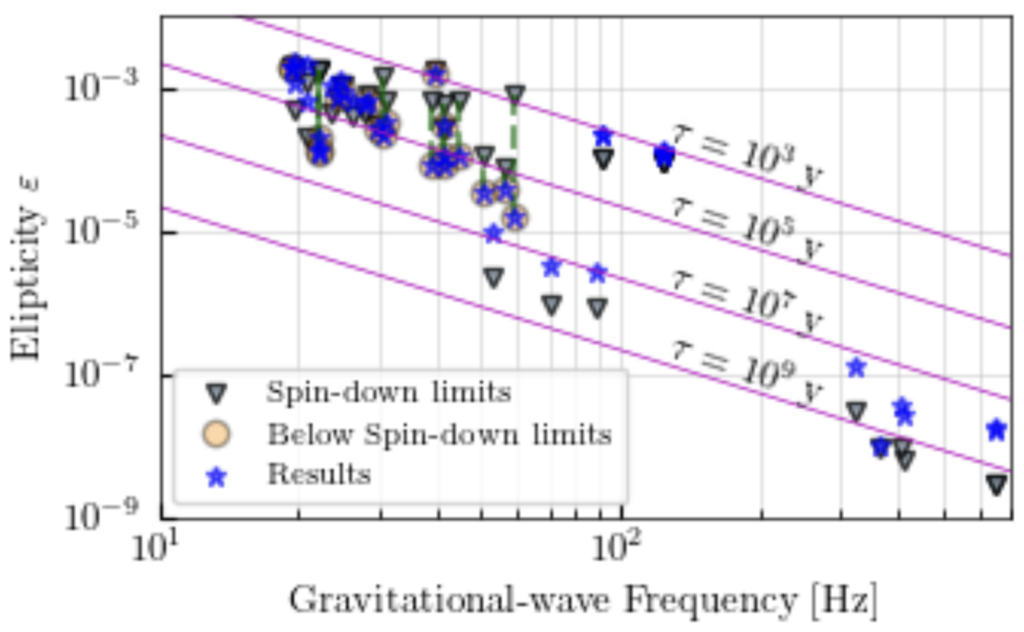
Figure 4. (Fig. 6 from our article) Stars: experimental upper limits on the ellipticity for each pulsar as a function of the expected CW frequency. Triangles: theoretical upper limits on the ellipticity, assuming that the spin down of the pulsars is completely due to the CW emission. Purple lines: pulsars of a certain age (τ in the figure), which lose energy through GW emission, should lie around the same line.
Our results in Figure 4 are compared with the so-called spin-down limits, a theoretical maximum amplitude for each of the stars. For more than half of our targets, we report an upper limit below the star’s spin-down ones, constraining the fraction of energy lost due to the CW emission. Our most stringent upper limit on NS ellipticity is for J0711-6830 (with an expected CW frequency around 364 Hz), corresponding to deformations of the star slightly above 100 microns (where one micron equals one millionth of a meter) for a radius of 10 km. Such limits also imply upper limits on the energy of the emitted CWs: in the case of the Crab pulsar (around 60 Hz), we find that the star loses at most only 0.04% of its energy through CWs emission!
While we did not find gravitational waves in this search, we improved our previous upper limits thanks to a longer data-taking period and to the detectors’ improvements. Overall, this is an important result because it puts tighter constraints on the theories that describe NSs and helps us get even closer to a comprehensive understanding of the complex physics of neutron stars.
Find out more
- Visit our websites:
- Read a free preprint of the full scientific article here or on arxiv
- Read an introduction to continuous gravitational waves here.
Back to the overview of science summaries.