
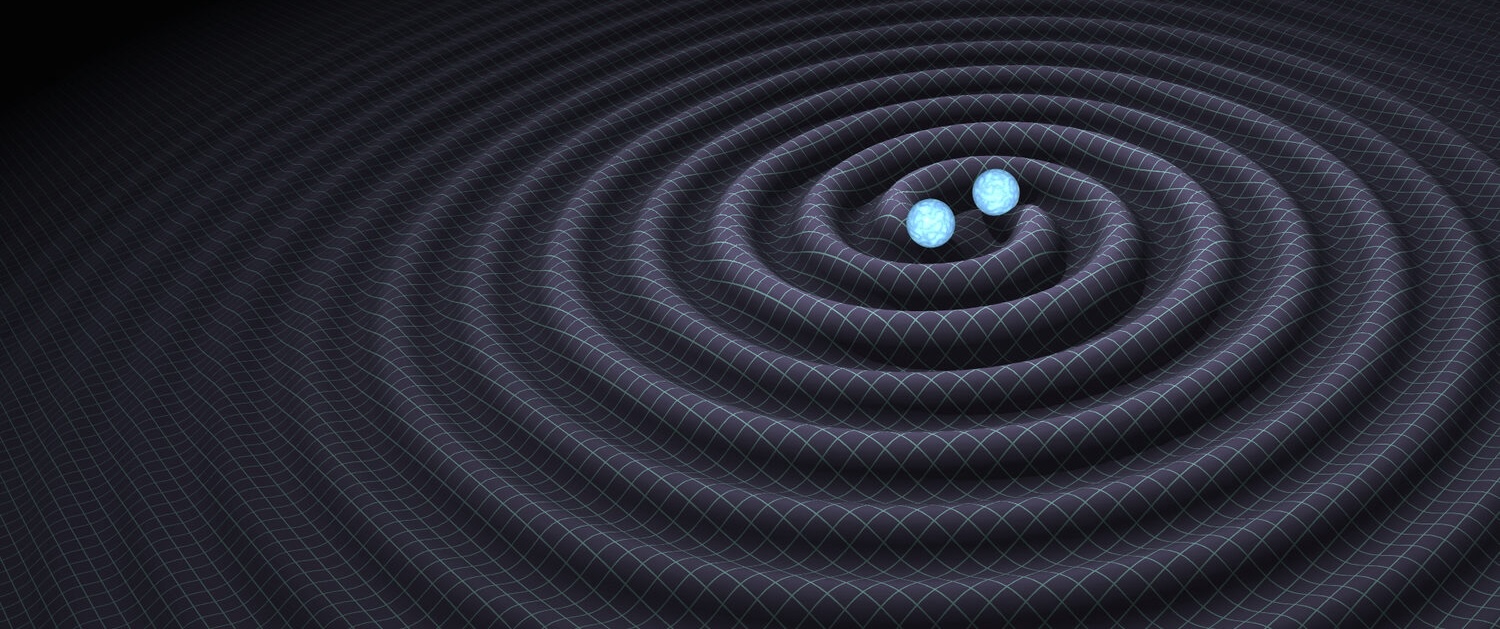
Einstein’s theory of General Relativity is currently the accepted theory of gravity. During the last 110 years since Einstein introduced General Relativity, it has been thoroughly tested in many ways, always passing with flying colors. Yet, the theory remains under constant scrutiny. Gravitational waves are a direct prediction of General Relativity, confirmed by the first direct observation of two merging black holes in September 2015. Observations of the inspiral and merger of stellar-mass black holes provide a unique opportunity to check whether General Relativity still holds in regimes of strong and highly dynamic gravity.
Over the last decade, the LIGO-Virgo-KAGRA (LVK) collaboration has routinely used catalogues of gravitational wave observations to test General Relativity. These tests confirmed that, if any deviations from General Relativity exist, they must be very small—below the detectors’ measurement capabilities. However, as more gravitational-wave events are observed, our tests become increasingly stringent. With 42 selected new high-significance black hole mergers detected during the first part of the current observing run (O4a), it is time to re-examine the validity of General Relativity with this expanded dataset.
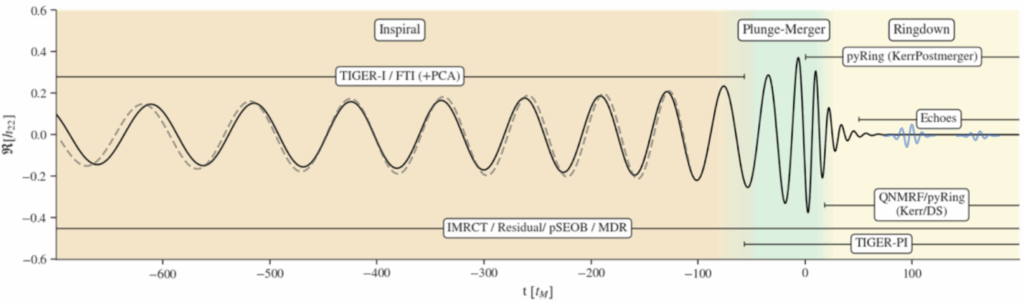
Figure 1: Gravitational wave signal from a binary black hole merger. The figure highlights the inspiral, plunge-merger and ringdown regions of the signal that are used for different tests of General Relativity. The name of the tests and the time interval over which each test is applied are also indicated. A hypothetical distorted signal, deviating from the General Relativity prediction, is shown as a dashed line. Possible “echoes,” expected if the merger remnant were not a black hole, are illustrated in blue.
How do we test General Relativity? General Relativity provides a well-established framework for describing gravity, and in recent decades great progress—both analytical and numerical—has been made in accurately modelling gravitational waves from compact-binary mergers. The tests of General Relativity are based on either (i) assessing the internal consistency of the theory across different stages of the coalescence, or (ii) searching for specific “distortions” of gravitational wave signals motivated by plausible violations of General Relativity.
Possible deviations from General Relativity could arise during the generation or propagation of gravitational waves, or because the merging objects are not black holes as described by General Relativity. However, these tests must be interpreted with care: fluctuations in the instrumental noise and limitations arising from the use of the computationally efficient (but slightly less accurate) gravitational waveforms can mimic apparent deviations from General Relativity, and must be carefully disentangled from genuine physical effects.
A plentitude of tests
The large number and high quality of available gravitational-wave observations allow LVK scientists to perform a wide variety of tests of General Relativity. Beyond the tests described in more detail below, our papers present several other tests that explore the consistency of weaker features (known as subdominant modes) of the gravitational-wave signals or examine whether black holes are deformed by their spin as expected. In addition, we examine whether the binary’s center of mass shows signs of acceleration—an astrophysical effect that, if not properly accounted for, could be misinterpreted as a deviation from General Relativity.
The first set of tests that we highlight here focuses on directly examining whether the evolution of black hole binary systems, as well as the emission and propagation of gravitational waves, deviates from Einstein’s predictions. For example, General Relativity predicts that gravitational waves travel at the speed of light and interact very weakly with matter. In contrast, some alternative theories of gravity (such as those involving a massive graviton or dark energy) suggest that gravitational waves may propagate at different speeds and experience dispersion—meaning that different frequencies arrive at slightly different times, similar to how radio waves disperse when traveling through a plasma. This can be tested by introducing additional parameters into the signal model that mimic the effects of alternative theories. If the data suggest that these parameters are consistent with zero, Einstein’s theory passes the test. Otherwise, the result may hint at new physics beyond General Relativity.
Another class of tests is designed to verify the overall consistency of the observed gravitational-wave signals with the predictions of General Relativity, or the internal consistency of different parts of the signal.
Overall consistency can be tested by subtracting the best-fit General Relativity waveform from the data and analyzing the residuals, comparing them against the expected instrumental noise. Since the observations we consider for these tests are made with at least two and sometimes three detectors, the consistency of the residuals across detectors—accounting for the light travel time between sites—provides an additional check: while a genuine gravitational-wave signal should appear as a correlated component across detectors, the instrumental noise in each detector is uncorrelated.
Internal consistency can be tested by dividing the signal into distinct segments and analyzing each part separately. If General Relativity is correct, the parameters of the gravitational wave inferred from different parts of the signal should agree. For example, the gravitational-wave signals detected by the LVK typically encode information from all three phases of a binary black hole coalescence: the inspiral of the two black holes, their merger, and the ringdown of the final black hole remnant. The “inspiral-merger-ringdown” consistency test compares the mass and spin of the remnant black hole inferred from the low-frequency inspiral phase with the values inferred from the high-frequency post-merger phase.
Similar to light waves, General Relativity allows only two transverse polarizations, called “plus” and “cross.” Polarization tests check whether gravitational waves possess only the two polarization states predicted by General Relativity, or if the wave’s gravitational field can oscillate in a more general way. However, alternative theories of gravity can have up to six independent polarization modes. The presence of additional polarization modes can be tested using observations from multiple detectors. (See Fig. 5 of this summary to find out more.)
The black hole formed in a binary merger is initially distorted by the violent dynamics of the coalescence. Like a struck bell releasing its vibrations as sound, the black hole emits gravitational waves. These waves are radiated at specific frequencies and decay over characteristic timescales, both determined by the final mass and spin of the remnant black hole. This forms the basis of the “no-hair theorem”: all distortions of the black hole —or “hairs”—are radiated away, leaving behind a final state described solely by two parameters. Much like a choir fading out at the end of a song, the black hole’s individual “voices”—the harmonic components of the ringdown—carry detailed information about their source. Therefore, scientists can learn about a black hole’s mass and spin by analyzing its ringdown frequency spectrum and decay time. Detecting a single harmonic —which is usually the case— allows for consistency checks with parameters inferred before and during the merger. The key feature of a black hole is its event horizon, beneath which no signals can escape – unlike a hard surface that could act as a reflective “mirror” and produce so-called “echo signals” in the post-merger, which we also search for.
Is Einstein correct, then?
For all the events considered, we find that the residuals are consistent with noise, indicating that the gravitational wave signals are well described by General Relativity. The final masses and spins, as inferred from the low- and high-frequency parts of the waveforms, are consistent with each other.
We also find no evidence for deviations from the predictions of General Relativity in either the generation or the propagation of gravitational waves encoded in the signals’ shape. Similarly, there is no indication of additional polarization modes beyond those predicted by General Relativity. However the present analysis places significantly tighter bounds on possible deviations from General Relativity, as illustrated in Figure 2 below.
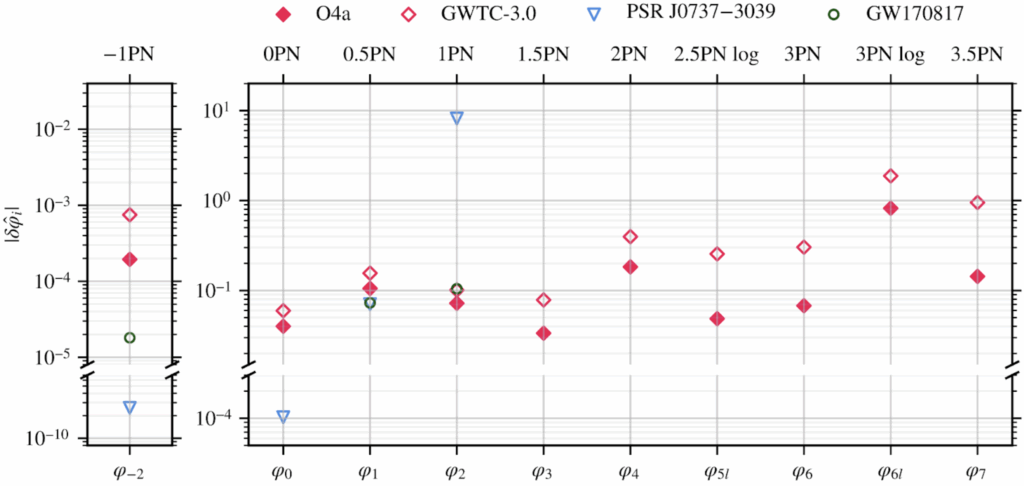
Figure 2: Constraints on the so-called post-Newtonian coefficients, which govern the phase of the gravitational-wave signal, are shown. These coefficients capture possible deviations from General Relativity at different stages of the binary evolution (from wide separations on the left to the late inspiral just before merger on the right). The current analysis yields significantly tighter bounds (lower values) on such deviations compared to earlier results.
Similarly, the ringdown analysis yields results consistent with the remnant black hole’s masses and spins estimated under the assumptions of General Relativity. We also find no signs of post-merger echoes, which would be expected if the remnant were not a black hole.
The LVK collaboration recently conducted tests of General Relativity using two exceptionally loud events not included in this work: GW230814, previously the loudest event ever detected (observed only by LIGO Livingston), and GW250114, the new record-holder for signal strength. Although GW230814 initially appeared promising for testing General Relativity, the absence of coincident data from other detectors prevented cross-checks for an excess of instrumental noise, highlighting the importance of multi-detector observations. In contrast, GW250114 – which was detected by both LIGO observatories – enabled high-precision tests of General Relativity, including a direct verification of Hawking’s area theorem and the tightest constraints yet on post-Newtonian and ringdown deviations. However, this event occurred later in the fourth Observing Run so is not part of the dataset considered in this work.
Overall, these results confirm that General Relativity continues to be consistent with gravitational wave observations, without requiring modifications or new physics. Furthermore, by combining the 42 newly tested events with earlier detections, we have placed even tighter constraints on possible deviations from General Relativity.
Find out more
- Visit our websites:
- This science summary is based on three new papers from the LVK Collaboration. Read a free preprint of the full scientific articles:
- Gravitational-Wave Open Science Centre data releases:
- Data for GW230814: https://doi.org/10.7935/amj3-kd70
- Data for GW250114: https://doi.org/10.7935/1g4j-2028
Back to the overview of science summaries.