
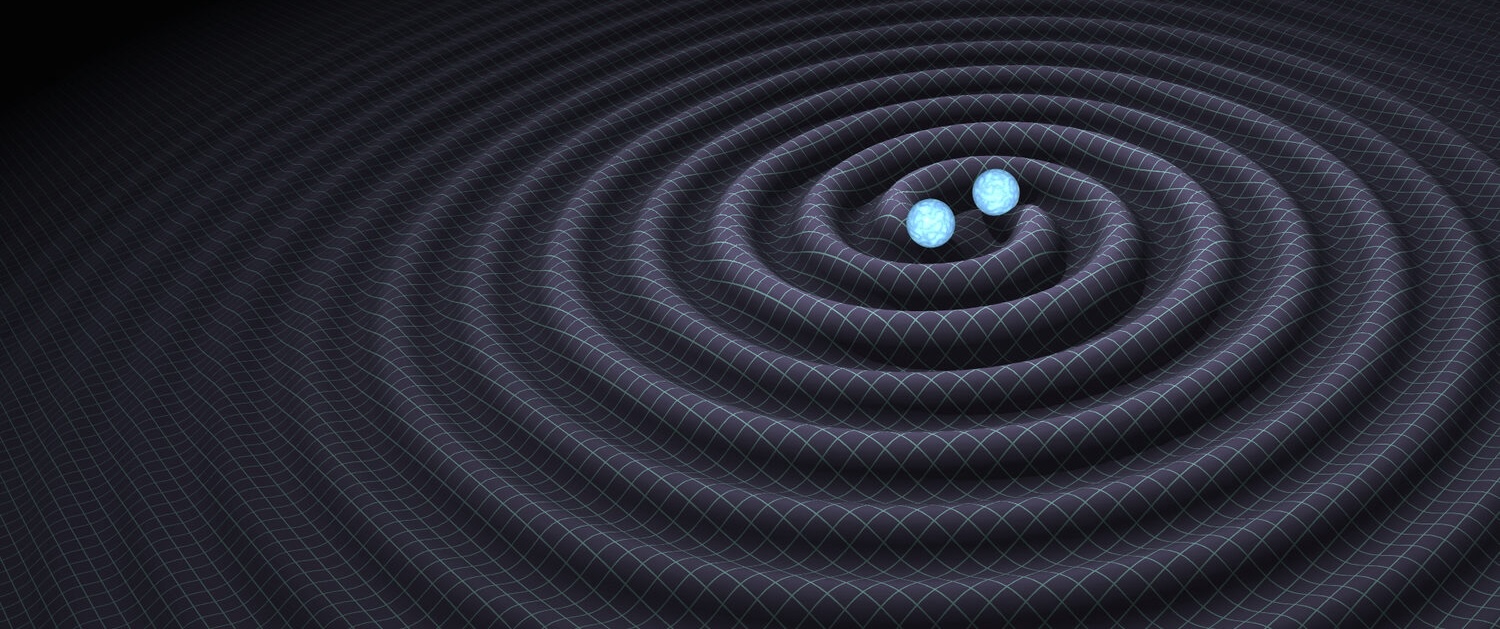
Every observing run of the LIGO Virgo KAGRA (LVK) network of gravitational-wave detectors offers an opportunity to detect more sources – the number of detected compact-object binary mergers is now in excess of 200 – and to perform deeper searches for sources that have not been observed yet. Among the latter, a fascinating target is mergers of compact objects with masses below the mass of the Sun (denoted by the symbol M⊙). Although there is no known astrophysical process to form such light objects from regular stars (see Figure 1), speculative processes could have formed for instance primordial black holes in the early Universe.
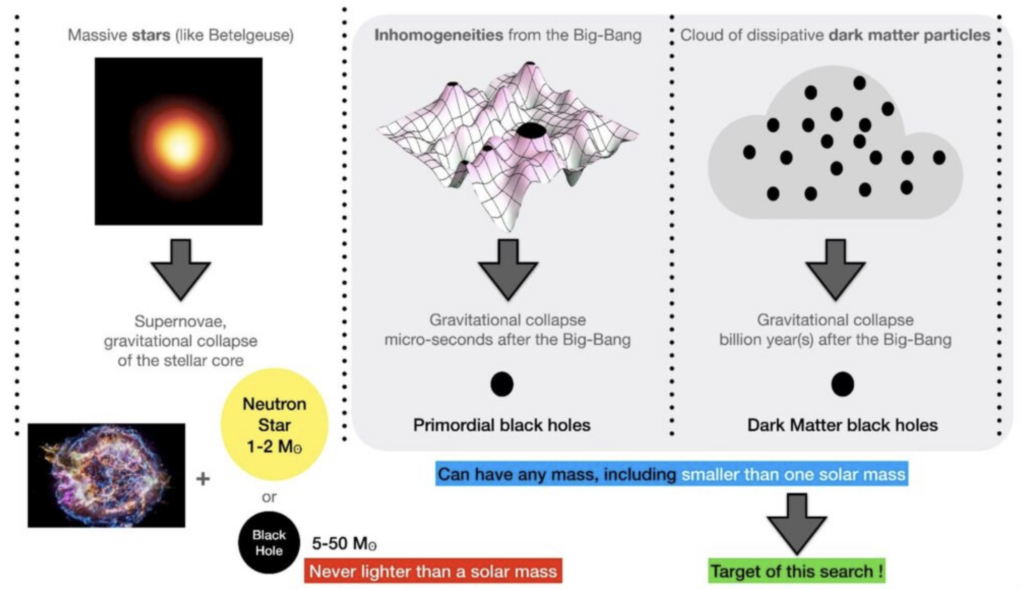
Figure 1: Sketch of the different pathways to form the compact objects that can be observed by LIGO-Virgo-KAGRA. Besides neutron stars and black holes formed by stellar evolution, there are hypothetical primordial or dark matter black holes that could exist in the Universe and be less massive than our Sun.
Mergers of light objects are generally not as powerful gravitational-wave emitters as those of heavier systems, but our detectors would nevertheless be sensitive to such sources if they are not too distant (typically within a tenth of a gigaparsec). Searching for them has a potential to reveal new physics. In the first part of the fourth LVK observing run (O4a), the LIGO detectors have collected data of unprecedented sensitivity, increasing their reach by 15% to 45% compared to the third observing run, and therefore probing a larger volume of the Universe.
Using three independent search pipelines (GstLAL, MBTA, PyCBC – all relying on our knowledge of the expected waveform but differing in their methods to separate signals from background noise and to estimate their statistical significance), we analyzed the O4a data to search for subsolar-mass mergers, where the lighter object in the binary has a mass between 0.2 M⊙ and 1 M⊙ and the heavier object has a mass between 0.2 M⊙ and 10 M⊙. To place this range in context, the lightest compact objects observed to date with gravitational waves all have masses constrained to be above 1 M⊙, while electromagnetic observations have shown evidence for a light neutron star with a mass estimated to be around 0.8 M⊙.
The search did not reveal any new detection candidate (but did pick up GW230529, see the science summary about this exciting discovery). However, from our non-detection, we were still able to derive upper limits on the rate of such events (see Figure 2). In order to do so, we quantify the sensitivity of our search by applying it to simulated signals of subsolar-mass binary black hole mergers added to the O4a data.
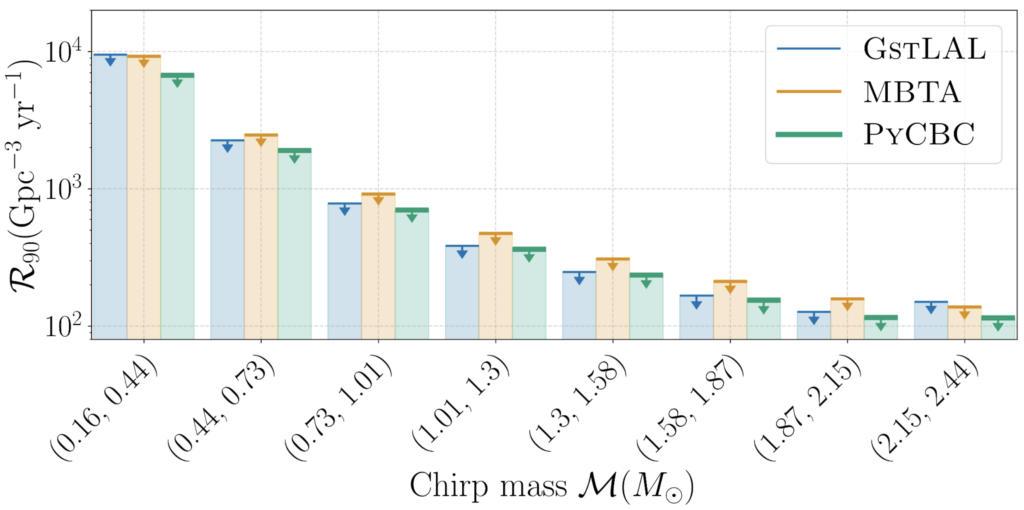
Figure 2 (Figure 5 from the paper): Upper limits on the merger rate of subsolar-mass binary black holes, as a function of the chirp mass, i.e. a combination of the two black hole masses that represents the effective mass of the binary system. The upper limits are inferred from the absence of detection in the O4a data and from the estimated sensitivity of the search performed by each pipeline.
For the first time, we also look at how sensitive our search is if the subsolar-mass objects in the binary are neutron stars. While neutron stars are not expected to have masses less than the Sun, if such low-mass neutron stars exist, tidal effects in the dynamics of the binary system – where the gravitational pull from one star induces a deformation in the other – are expected to play an important role. This is because the deformation, subtle in typical neutron stars, would become significant in low-mass stars. Since our search assumes the objects are black holes, i.e. point particles without any tidal effects, it may not capture perfectly a signal from subsolar-mass neutron star mergers. We quantify the sensitivity of the search in this specific case by applying it to simulated subsolar-mass binary neutron star mergers and determining how often a signal is detected.
The merger rate upper limits can be recast into constraints on models of dark matter that predict subsolar-mass binary black hole mergers. One such model predicts that primordial black holes may have formed in the early Universe and paired to form binaries that eventually merge. We derive maximum values for the fraction of dark matter that primordial black holes could represent, depending on various assumptions about their mass and the binary formation scenario. Another class of models considers the possibility that dark matter is composed of (unknown) particles that can interact with their environments such that they can accumulate in dense regions and ultimately collapse to form black holes. These are referred to as “dark black holes” (or “dark matter black holes” – see Fig. 1) as they would originate from dark matter. The dark black holes may then form binaries and merge, with their inspiral leaving a gravitational-wave signal. Although again this search produced no detections, this null result allows us to constrain the extent to which dark matter could be composed of dark black holes, in the subsolar mass range considered here.
The O4 observing run has continued until November 2025 and accumulated much more data, which gives an opportunity to deepen the search and opens the prospect for either making a detection or establishing tighter constraints. Stay tuned!
Find out more
- Visit our websites:
Back to the overview of science summaries.