
Background
On Earth, we probe cosmic phenomena, such as colliding or exploding stars, jetting galactic cores, via detecting their emitted signatures, so-called messengers. There are three distinct kinds of messengers: electromagnetic waves, gravitational waves, and particles. Humanity has built sensitive detectors that can sense these messengers arriving from immense distances in the Universe. In the past decade, both gravitational waves and astrophysical high-energy neutrino particles have been detected independently and in combination with electromagnetic waves. What had been perceived decades ago as a hopeless pioneering vision, has now been transformed into a flagship mission for funding agencies. Today, this vision is commonly referred to as multi-messenger astrophysics.
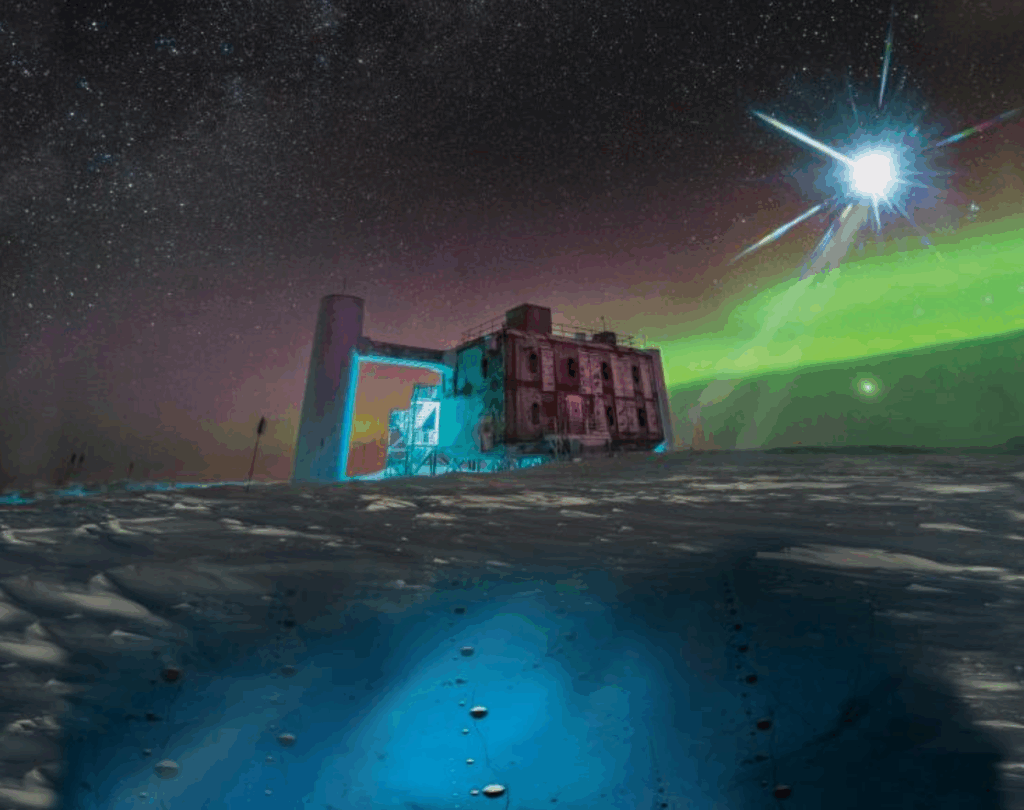
Figure 1: The IceCube High-Energy Neutrino detector is positioned approximately a few km beneath the geographic South Pole in Antarctica, using an expansive cubic kilometer of immaculate ice volume for its instrumentation. The IceCube Collaboration has deployed 5160 advanced optical modules that detect light emissions resulting from interactions of neutrinos within the ice. IceCube maintains more than 99% uptime, an exemplary level of performance, enabling the observation of neutrinos from the entire sky. IceCube observed neutrinos from a range of origins, including a diffuse flux potentially with unresolved point sources, the blazar TXS 0506+056, the active galaxy NGC 1068, and from the Milky Way. [Image credit: IceCube/NSF]
Over the past decade the field of multi-messenger astrophysics has matured dramatically – with to date more than two hundred gravitational-wave events detected, comprising the mergers of binary black holes, binary neutron stars, and neutron star-black hole systems, while over the same period, neutrino detectors have amassed an unprecedented dataset. The game-changing multi-messenger observation of a merging binary neutron star system established connections between gravitational wave sources and emissions across the electromagnetic spectrum, from gamma-rays to radio. What was conspicuously missing from this observed multi-messenger repertoire is the high-energy neutrinos that should be present but so far have gone unobserved. On the other hand, an intertwined signature from a common cosmic source of neutrinos and gravitational waves may reach our corner of the Universe at any instant. Such a joint detection would offer deep insight into cosmic and astrophysical processes.
Multi-messenger search
Multi-messenger searches including gravitational waves were first pioneered more than two and a half decades ago, and have led to some of the most significant astrophysical discoveries of recent times. Since we expect cosmic sources to emit multiple types of messengers at the same time, it is a natural choice to combine data from the disparate detectors and analyze them in unison. An astrophysical source observed from overlapping skymaps and time windows is a real cosmic treasure. This is the basis of multi-messenger search techniques. Gravitational waves carry a fingerprint of the astrophysical source as the waveform reveals, for example, masses and spins of merging black holes or neutron stars. On the other hand, neutrinos carry complementary information about the emitting source, and we infer the likelihood that they are a real signal from the energy they deposit in the detector. Most of the detected neutrinos are background from atmospheric processes and not astrophysical. Similarly, for gravitational waves, for every loud signal discovered, there are numerous weak fingerprints called subthreshold candidates, not sufficiently loud to claim a detection. Leveraging data from the LIGO, Virgo, and IceCube observatories, we conducted an archival investigation of multi-messenger event candidates. In the publication, we look at all gravitational wave candidates, including subthreshold ones, as they may reach detection level when a potential neutrino counterpart is considered.
Results and outlook
The discovery and multi-messenger observation of cosmic sources involving high-energy neutrinos and gravitational waves offer great potential to improve our understanding of cosmic source dynamics, the origins of the highest-energy neutrinos and cosmic rays, and high-energy emissions from gravitational-wave sources. These insights will also enable more effective electromagnetic follow-up efforts. A thorough analysis of data from LIGO and Virgo, alongside coincident IceCube event candidates, has greatly expanded the available dataset, allowing for a deeper and more comprehensive search compared to previous efforts.
The LLAMA1 data analysis, using a model-dependent optimal statistical approach, was applied to all confident and sub-threshold gravitational-wave events from the third observation run of LIGO-Virgo-KAGRA, and time-coincident IceCube event candidates. This analysis considered neutrino emission within a 1000-second time window centered around the gravitational-wave emission time. Although no significant neutrino emission was detected for individual gravitational-wave events, the joint skymaps clearly demonstrated how multi-messenger searches can effectively guide the observing strategies of electromagnetic observatories.
While no definitive detection was made, the analysis provided important constraints on the population of cosmic multi-messenger sources involving both gravitational waves and neutrinos. These improved limits help refine our understanding of the fraction of gravitational-wave sources that emit high-energy neutrinos, particularly at very high energies and for isotropic emissions. Additionally, we learned that the joint detection of gravitational waves and high-energy neutrinos is limited by current neutrino detection capabilities, highlighting the need for the next generation of neutrino detectors.
Real-time multi-messenger LLAMA searches, involving high-energy neutrinos and gravitational waves, are actively running on both confident and sub-threshold event data during subsequent observing runs. This successful operation demonstrates enhanced performance, expanding the range of compact object mergers being explored. The increased rate of exploration offers more opportunities for multi-messenger studies and boosts the chances of discovering common sources of neutrinos and gravitational waves in the future.
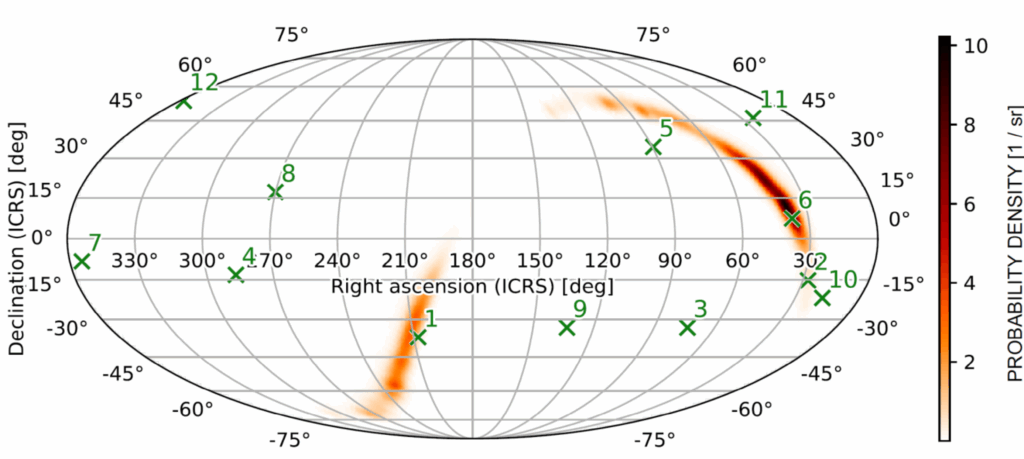
Figure 2: Joint skymap showing all neutrino candidates coincident with binary neutron star gravitational wave candidate on January 4th 2020 at 3:08:48 UTC (Coordinated Universal Time). Neutrino#6 is the most significant candidate in the O3 sub-threshold trigger set under merging binary interpretation.
Third-generation gravitational-wave detectors are currently being designed to expand their cosmic volume reach by orders of magnitude. At the same time, the next-generation IceCube Neutrino Observatory aims to significantly increase its instrumented volume and detect neutrino energies up to several hundred PeVs (1 PeV is a quadrillion electron-volts). With these future detectors, we anticipate a substantial rise in both the rate and quality of observations, offering exciting opportunities for comprehensive multi-messenger discoveries with LLAMA, involving neutrino, electromagnetic, and gravitational wave messengers.
Find out more:
- Visit our websites:
- Read a free preprint of the scientific article on arxiv.
- Learn about neutrinos and the IceCube Neutrino Observatory: https://icecube.wisc.edu/
- What is new in IceCube-Gen2? Go to https://icecube-gen2.wisc.edu/ and read about the future of neutrino detection at Antarctica, which will shape multi-messenger astrophysics.
1 LLAMA (Low-Latency Algorithm for Multimessenger Astrophysics) system is the first pioneering real-time data analysis pipeline developed by Columbia University researchers. The current software suite is the culmination of persistent, efficient, and leading effort that started in 2006 and initially dedicated to searches for joint sources of gravitational waves and high-energy neutrinos. LLAMA is powered by a state-of-the-art Bayesian statistics2 framework to assess the observed data from all messengers on an equal footing. LLAMA creates a single virtual detector, merging gravitational wave, neutrino, and electromagnetic observations optimally. It evaluates the significance that the different messengers arrived from the same astrophysical source as opposed to being a chance coincidence. LLAMA can run on archival data, as in this publication. LLAMA can also operate in real time and alert astronomers to point their telescopes in the direction of a joint candidate neutrino immediately after a detection.
2 Bayesian statistics: Since an optimal model-independent multi-messenger search does not exist, it is a natural choice to include prior information about the assumed astrophysical source and the detectors whose data are used in the analysis to discern the significance of any observed coincidences. Using prior knowledge in this way differs from the also widely used frequentist methods, which evaluate significance through repeated well-constructed experiments.
Back to the overview of science summaries.