
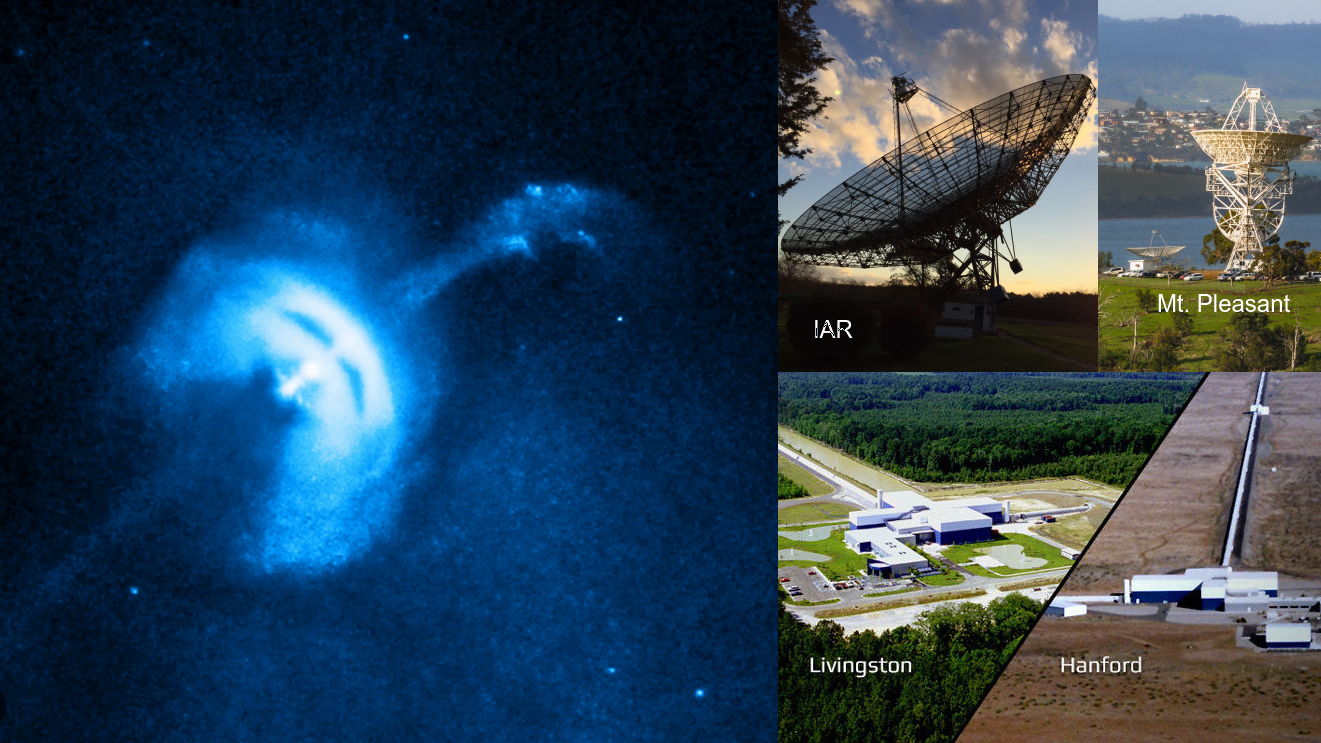
In a scientific article submitted to The Astrophysical Journal and available online as a free preprint (https://arxiv.org/abs/2512.17990), the LIGO-Virgo-KAGRA Collaboration reports the most stringent results yet on possible gravitational waves from a glitching pulsar. This target, known as the Vela pulsar, is a rapidly rotating neutron star in our galactic neighborhood for which radio telescopes observed a strange irregularity known as a “glitch” in 2024, during the fourth observing run (O4) of the LIGO-Virgo-KAGRA gravitational-wave detector network.
Pulsars emit electromagnetic radiation that is detected on Earth as a pulse every time it sweeps across us, like a lighthouse beam. A glitch is a kind of hiccup in a pulsar’s otherwise steady radio signals. The physical processes behind pulsar glitches are complex and still not fully understood, and detecting their aftermath in the form of gravitational radiation could be a crucial step to solving this puzzle: it may provide important insights into properties of its crust and of superfluids in its interiors.
The Vela pulsar, located about a thousand light-years from Earth, is a well-known pulsar that has also been covered by many searches for long-term continuous gravitational wave emission, most recently in the LVK paper published as Astrophys. J. 983, 99 (2025). In this new analysis, however, collaboration scientists looked for transient signals emitted at or after the glitch. The glitch was first reported by the Argentine Institute of Radioastronomy (IAR), and the LVK work is based on high-resolution timing of the Vela pulsar by both the IAR and the Mount Pleasant Observatory of the University of Tasmania.
In the article submitted jointly by LVK, IAR and U. Tasmania scientists, no detection of post-glitch gravitational waves from the Vela pulsar has been reported, but it nevertheless constitutes a milestone for pulsar glitch studies: for the first time, the sensitivity of the LIGO detectors during the O4 run has become so exquisite that the direct observational constraints on the emitted gravitational-wave amplitude are stricter than indirect arguments based on the glitch parameters observed in the radio. In other words, the most optimistic assumptions about possible gravitational radiation from this Vela pulsar glitch could be ruled out observationally.
The article has been submitted for peer review at The Astrophysical Journal. The full preprint is available at https://arxiv.org/abs/2512.17990 or https://dcc.ligo.org/P2500086/public and a summary for general audiences is available at https://ligo.org/science-summaries/VelaGlitch/ and translations of the science summary are also available for the following languages: