
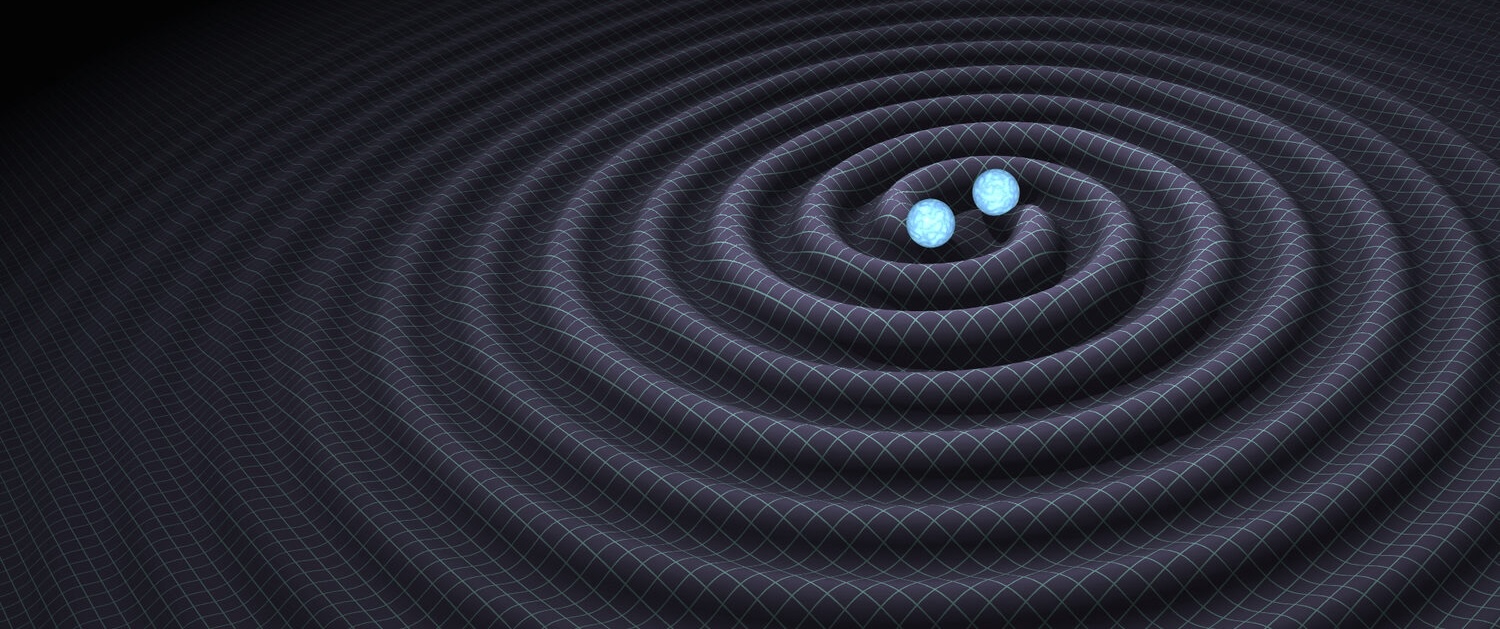
On 12 May 2026, the LIGO-Virgo-KAGRA Collaboration announced the discovery of two binary black hole systems observed during the fourth observing run: GW240925 and GW250207. Both systems had very high signal-to-noise ratios of 32 and 69, respectively. This allowed the first informative application of a technique called astrophysical calibration.
![Infographic: properties of GW240925 and GW250207. [Credit: S. Galaudage / Northwestern U./ Adler Planetarium / LVK Collaboration.]](https://ligo.org/wp-content/uploads/2026/05/GW240925_GW250207_ENGLISH_Events-1024x576.png)
Publications & Documentation
- Publication: GW240925 and GW250207: Astrophysical Calibration of Gravitational-wave Detectors , Physical Review Letters. [arXiv pdf download]
- News Release
- Science Summary [pdf flyer]
- Data release for GW240925/GW250207 (Gravitational Wave Open Science Center/GWOSC).
- See the main ligo.org detection page for further resources.
![Infographic: detector calibration.[Credit: S. Galaudage / Northwestern U./ Adler Planetarium / LVK Collaboration.]](https://ligo.org/wp-content/uploads/2026/05/GW240925_GW250207_ENGLISH_Calibration-1024x576.png)
![Infographic: analogy between astrophysical calibration music auto-tuning. [Credit: S. Galaudage / Northwestern U./ Adler Planetarium / LVK Collaboration.]](https://ligo.org/wp-content/uploads/2026/05/GW240925_GW250207_ENGLISH_AstroCalibration-1024x576.png)
![Infographic: improving sky localization via astrophysical calibration. [Credit: S. Galaudage (Northwestern U. & Adler Planetarium) / S. Biscoveanu / LVK Collaboration.]](https://ligo.org/wp-content/uploads/2026/05/GW240925_GW250207_ENGLISH_SkyMap-1024x576.png)
Additional Images/Media
![Artistic impression of astrophysical calibration. [Credit: C. Knox, OzGrav/Swinburne]](https://ligo.org/wp-content/uploads/2026/05/Instrumentation_Calibration_-_Carl_Knox_-_OzGrav_Swinburne_University_Of_Technology-1024x559.png)