
On May 26, 2026, the LIGO-Virgo-KAGRA Collaboration released results from the second part of their fourth observing run (O4b). This fifth Gravitational-Wave Transient Catalog (GWTC-5.0) includes a cumulative collection of all gravitational-wave signals observed by the LVK to date. It includes 161 new significant signals from compact binary coalescences. This brings the number of detections to 390. Additional information can be found in the publications, companion papers, science summaries, and other resources below.
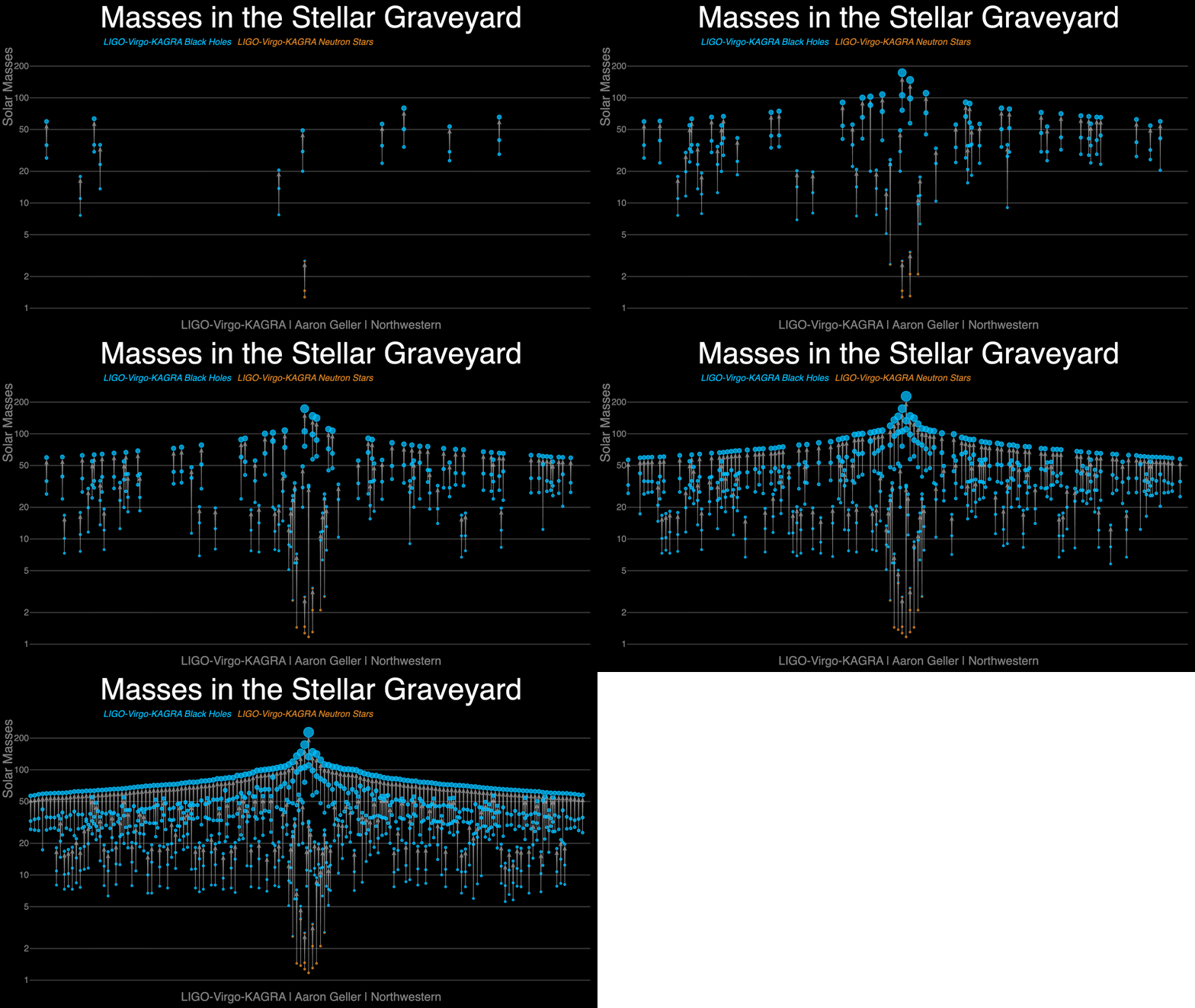
GWTC-5.0 masses in the stellar graveyard animation. Each dot represents a compact object, with black holes and neutron stars discovered by the LVK in blue and orange. The vertical axis shows the masses of each object. Arrows connect the component masses of LVK binaries that merged to form a compact object with larger mass. Each frame in the animation shows binaries discovered in subsequent observing periods. [LVK/A. Geller/Northwestern]
Publications & Documentation
- Publication (introduction): GWTC-5.0: An Introduction to Version 5.0 of the Gravitational-Wave Transient Catalog (submitted for publication). [pdf download from LIGO DCC] [arXiv version].
- Publication (methods): GWTC-5.0: Methods for Identifying and Characterizing Gravitational-wave Transients (submitted for publication). [pdf download from LIGO DCC] [arXiv version].
- Publication (results): GWTC-5.0: Observations from the Second Part of the Fourth LIGO-Virgo-KAGRA Observing Run and Updates to the Gravitational-Wave Transient Catalog (submitted for publication) [pdf download from LIGO DCC] [arXiv version].
- News Release.
- Science Summary [pdf flyer].
- Companion Papers:
- GWTC-5.0: Constraints on the Cosmic Expansion Rate and Modified Gravitational-wave Propagation (submitted for publication). [pdf download from LIGO DCC] [arXiv version].
See also the associated science summary [pdf flyer]. - Open Data from LIGO, Virgo, and KAGRA through the Second Part of the Fourth Observing Run (submitted for publication). [pdf download from LIGO DCC] [arXiv version].
See also the associated science summary [pdf flyer]. - GWTC-5.0: Population Properties of Merging Compact Binaries (submitted for publication). [pdf download from LIGO DCC] [arXiv version].
See also the associated science summary [pdf flyer].
- GWTC-5.0: Constraints on the Cosmic Expansion Rate and Modified Gravitational-wave Propagation (submitted for publication). [pdf download from LIGO DCC] [arXiv version].
- Data release for O4B Catalog/GWTC-5.0 (Gravitational Wave Open Science Center/GWOSC).
- See the main ligo.org detection page for further resources.
![GWTC-5.0 masses in the stellar graveyard. Each dot represents a compact object, with black holes and neutron stars discovered by the LVK in blue and orange. Black holes and neutron stars discovered via electromagnetic observations are in magenta and yellow. The vertical axis shows the masses of each object. Arrows connect the component masses of LVK binaries that merged to form a compact object with larger mass. Each gravitational-wave binary is plotted in order of increasing total mass. [LVK/A. Geller/Northwestern]](https://ligo.org/wp-content/uploads/2026/05/Stellar-Graveyard-GWTC5_rising-1024x576.png)
![Panel of time-frequency spectrograms for GWTC-5.0. Each panel shows time vs. frequency for an individual gravitational-wave event (the merger of two black holes, two neutron stars, or one of each). The rising “swoosh” visible in most panels shows how the gravitational wave signal from a compact binary merger grows louder and higher-pitched right before the final collision. Events are arranged by the labeled observing runs, with each highlighted by a different color scheme. O1 had 3 events; O2 had 8, O3 observed 79 events. O4a originally contained 128 events presented in GWTC-4.0; these have been supplemented with 11 additional events released as part of GWTC-5.0. The O4b observing run releases 161 new events, with the GWTC-5.0 catalog now totaling 390 events across all observing runs. [Image credit: R. Nowicki/B. Smith/K. Jani (LVK/Vanderbilt)]](https://ligo.org/wp-content/uploads/2026/05/GWTC5-EPO-landscape-1024x728.jpg)
Additional Images
![GWTC-5.0 “petri dish” plot. The disk is broken up into segments corresponding to the LVK observing runs O1, O2, O3, and O4. Gravitational-wave events observed in each run are plotted as colored circles and arranged as a function of time from the start of each run, with time increasing as a clockwise angle from the vertical. The size of each circle is proportional to the binary’s mass. Darker circles indicate higher SNR (signal-to-noise ratio), while distance from Earth is indicated by distance from the disk’s center. Selected event names are labeled. [D. Davis, R. Udall/LVK]](https://ligo.org/wp-content/uploads/2026/05/GWTC_neighborhood_annotated_extra-1024x615.png)
![Time-frequency spectrograms showing new gravitational-wave events released in GWTC-5.0 with false alarm rates of 1/year or less. The blue line in each plot is the "inspiral" track in the time-frequency plane. [Image credit: D. Davis/LVK]](https://ligo.org/wp-content/uploads/2026/05/GWTC5_spectrograms_tracks-1024x860.png)