
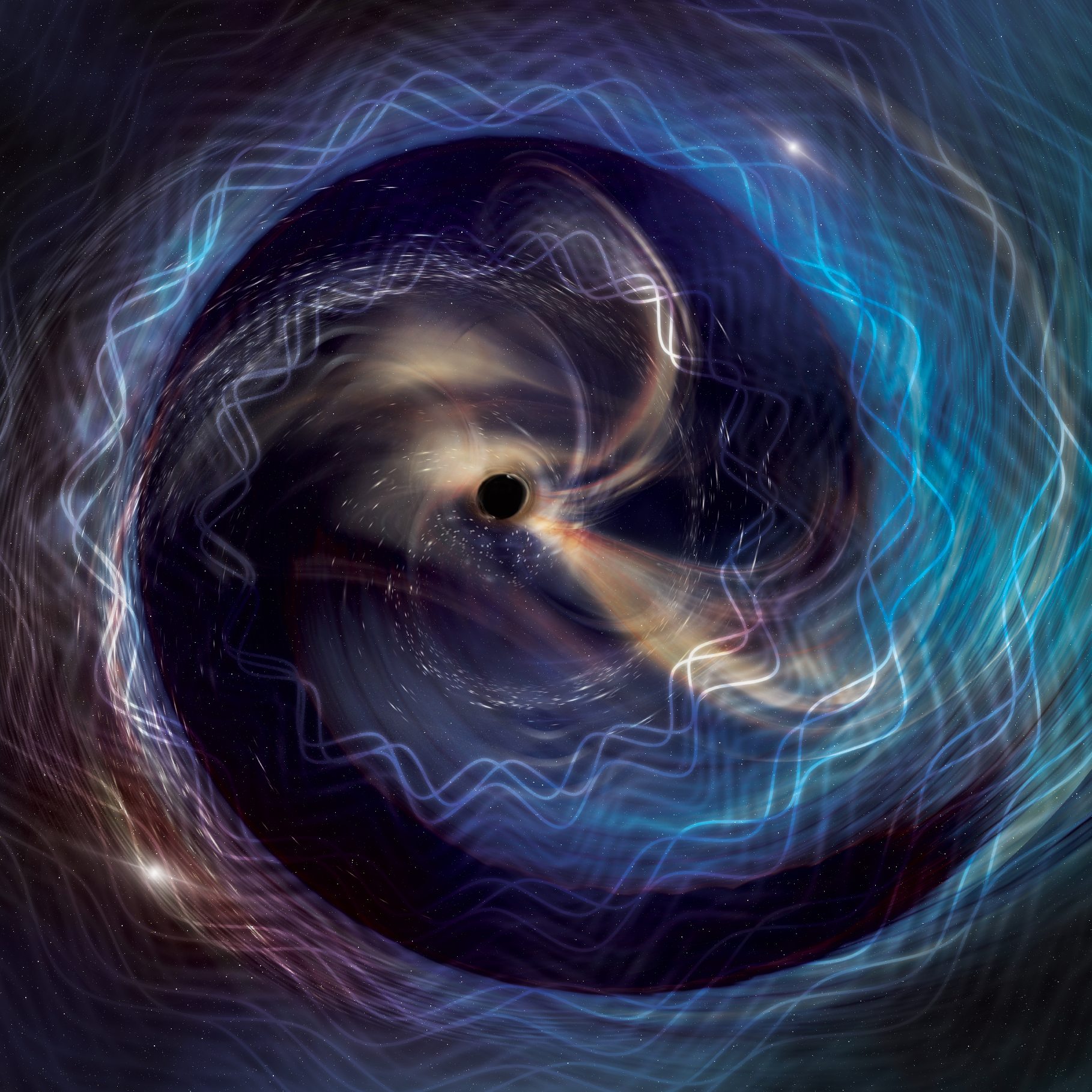
In January 2025, the LIGO-Virgo-KAGRA collaboration observed an exceptionally loud gravitational-wave signal: GW250114. It stands out as the clearest one observed thus far, about three times louder than the first detection in 2015. The signal matches what is expected when two black holes of nearly equal mass and low spin spiral together, collide, and settle into a single, larger black hole.
Because of its exceptional loudness, GW250114 provides a unique opportunity to test whether Einstein’s theory of general relativity holds in the most extreme conditions: the rapidly changing, intense gravitational fields near merging black holes. In particular, detecting multiple ringdown tones, and checking whether they are consistent with the expected frequencies and decay times, provides a powerful test of general relativity. Such measurements not only probe the black hole no-hair theorem, but also allow searches for generic deviations from Einstein’s predictions, whether arising from exotic black-hole features or more fundamental modifications to the theory of gravity.
According to the results published in Physical Review Letters , GW250114 matches the expectations of general relativity in every test. The strength and clarity of this signal make it the most precise confirmation yet of Einstein’s theory for black hole mergers. In some cases, the tests based on this signal alone are two to three times more stringent than those obtained by combining data from dozens of other signals. Together with the detection paper, which tests Hawking’s area law and provides complementary results on the Kerr nature of the remnant, this study illustrates the amazing breadth of science unlocked by GW250114.
As the LIGO‑Virgo‑KAGRA collaboration celebrates a decade since the first detection of gravitational waves from merging black holes, dramatic improvements in detector sensitivity now allow us to record signals such as GW250114 with unprecedented clarity. Each new advance promises even louder signals in the future. GW250114 is therefore a preview of the transformative science that upcoming observing runs will enable.