
Today, the international LIGO-Virgo-KAGRA Collaboration celebrates the successful completion of its fourth observing run (O4), marking another major step forward in the exploration of the gravitational wave universe. The run, which began May 24, 2023 and continued through November 18, 2025, relied on coordinated observations and analyses by teams across the world.
During O4, the detectors observed roughly 250 candidate signals in real time. Comprehensive analysis of the first (of three) segments of O4 yielded 128 significant events (an increase of around 50% compared to those announced in real time). These results were reported in the most recent update to the Gravitational-Wave Transient Catalog (GWTC-4.0). Data from the remaining two segments of O4 are currently under detailed examination. The collaboration expects that further results will emerge in the coming months as analyses continue.
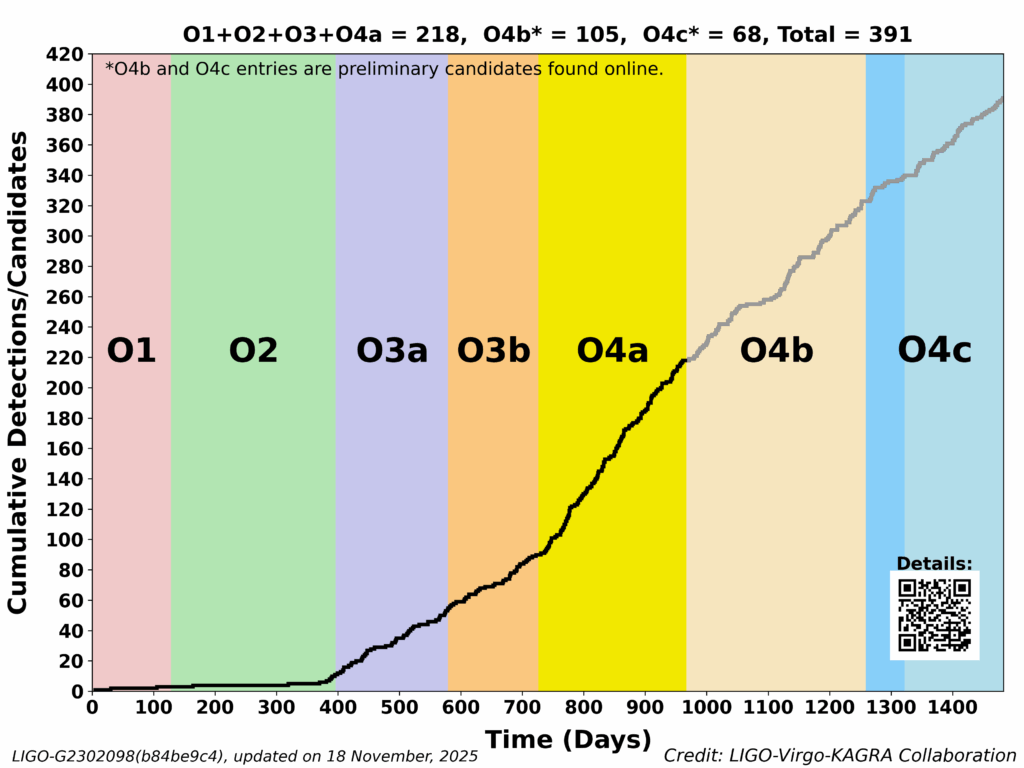
Compared to the first three observing runs, which detected 90 signals combined, O4 has already more than doubled the number of confident gravitational wave detections, with many more left to analyze. This demonstrates a continuous increase in both detector sensitivity and scientific return. Indeed, throughout the four observing runs to date, the collaboration has significantly improved its detector technologies, theoretical modeling, low-latency alert system, and data analysis methods. These developments have already led to numerous new discoveries and refined our understanding of, for example, the nature of compact binary systems and fundamental physical processes in the universe.
“This is the longest observing run undertaken in either the initial or advanced LIGO era,” said Stephen Fairhurst, spokesperson of the LIGO Scientific Collaboration. “It has been a fantastically successful run, with over 250 significant gravitational wave candidates released in low latency and already over twenty papers released describing the scientific results from O4, with many more to come.”
Following the conclusion of O4, the observatories will undergo a planned break for maintenance and upgrade work. With these improvements, the collaboration anticipates even more frequent and detailed detections, offering new opportunities to probe the most extreme and fascinating phenomena in nature.
After recent assessments of upgrade phasing and discussions with funding agencies, we now expect to have a period of science observing in 2026-27. We currently envision a six-month observing run to begin in the late summer/early fall of 2026, with detectors participating as available. We look forward to sharing more details about this observing run as they emerge.
The LIGO-Virgo-KAGRA Collaboration
LIGO is funded by the United States National Science Foundation (NSF), and operated by Caltech and MIT, which conceived and built the project. Financial support for the Advanced LIGO project was led by NSF with Germany (Max Planck Society), the U.K. (Science and Technology Facilities Council) and Australia (Australian Research Council) making significant commitments and contributions to the project. More than 1,600 scientists from around the world participate in the effort through the LIGO Scientific Collaboration, which includes the GEO Collaboration. Additional member institutions are listed at https://my.ligo.org/census.php.
The Virgo Collaboration is currently composed of approximately 1000 members from over 150 institutions in 15 different (mainly European) countries. The European Gravitational Observatory (EGO) hosts the Virgo detector near Pisa in Italy, and is funded by Centre National de la Recherche Scientifique (CNRS) in France, the National Institute of Nuclear Physics (INFN) in Italy, the National Institute of Subatomic Physics (Nikhef) in the Netherlands, The Research Foundation – Flanders (FWO) and the Belgian Fund for Scientific Research (F.R.S.–FNRS) in Belgium. More information is available on the Virgo website at https://www.virgo-gw.eu.
KAGRA is the laser interferometer with a 3 km arm-length in Kamioka, Gifu, Japan. The host institute is Institute for Cosmic Ray Research (ICRR), the University of Tokyo, and the project is co-hosted by National Astronomical Observatory of Japan (NAOJ) and High Energy Accelerator Research Organization (KEK). KAGRA collaboration is composed of over 400 members from 128 institutes in 17 countries/regions. KAGRA’s information for general audiences is available at https://gwcenter.icrr.u-tokyo.ac.jp/en/. Resources for researchers are accessible from http://gwwiki.icrr.u-tokyo.ac.jp/JGWwiki/KAGRA.