
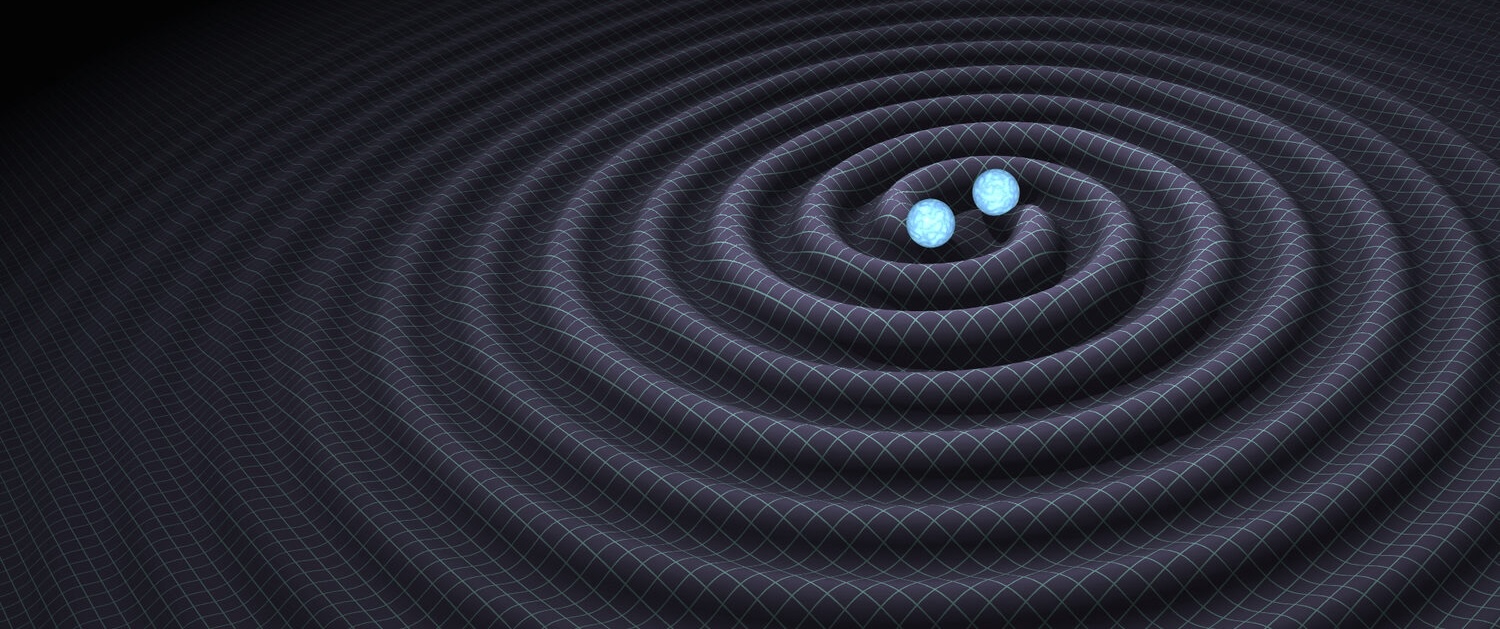
Neutron stars (NSs) are among the most exotic objects in the Universe. They are born when massive stars die in energetic explosions that we call core-collapse supernovae. These explosions rip the star apart and leave behind a beautiful diffuse nebula called a supernova remnant (see Figure 1). The NS sits near the center of the supernova remnant when young and gradually moves away as the remnant expands into the interstellar medium.
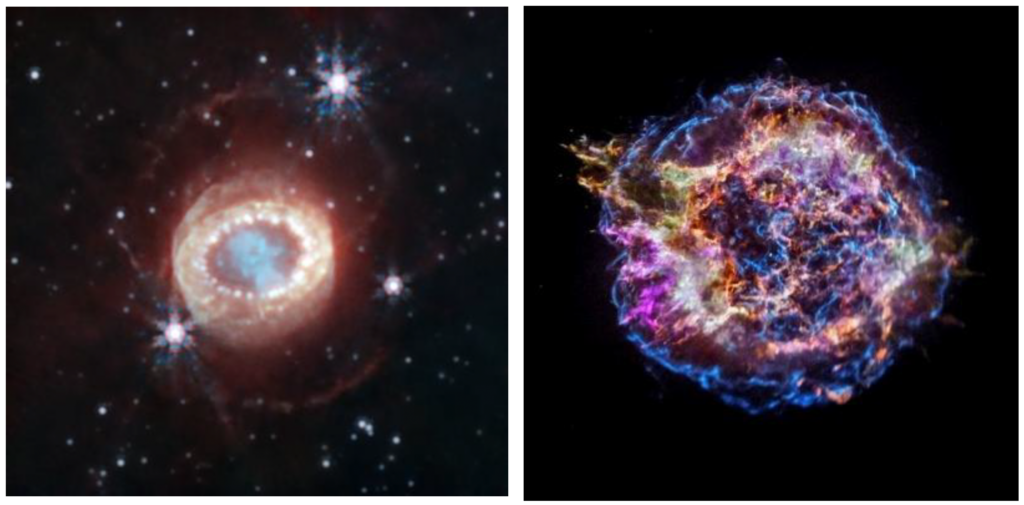
Figure 1: Left: The youngest remnant in our targets’ list, SN 1987A located in the Large Magellanic Cloud some 50 kpc away, as seen by the James Webb Space Telescope (JWST)’s NIRCam. JWST revealed growing evidence for the presence of a neutron star near the center heating the material in the remnant’s interior. Image credit: NASA, ESA, CSA, Mikako Matsuura (Cardiff University), Richard Arendt (NASA-GSFC, UMBC), Claes Fransson (Stockholm University), Josefin Larsson (KTH); Image Processing: Alyssa Pagan (STScI). Right: The supernova remnant Cassiopeia A, one the youngest and brightest known core-collapse supernova remnants in our Galaxy, as seen by the Chandra X-ray Observatory. The central white dot is a point-like X-ray source believed to be the neutron star left behind the supernova explosion and known as a ‘Central Compact Object’. Image credit: X-ray: NASA/CXC/Meiji Univ./T. Sato et al.; Image Processing: NASA/CXC/SAO/N. Wolk.
Neutron stars are extremely dense objects, with more than the mass of the Sun packed into the size of a city. Their makeup and underlying physics remain some of the most intriguing open questions in science, drawing interest from astrophysics, nuclear and particle physics, and condensed matter physics. They are also the strongest magnets in the Universe. They can rotate astonishingly fast, with some rotating hundreds of times per second. They are traditionally discovered as “pulsars” as they emit pulses of light that sweep across the line of sight to the earth once or twice for every rotation they make around their spin axis. But not all NSs are detected as pulsars, and their interiors are mostly far from reach even to the most sensitive electromagnetic telescopes on Earth and in space. Continuous gravitational waves (CWs) provide a new tool to discover previously missed pulsars and probe their exotic interiors.
CWs are steady, long-lasting ripples in space-time that a NS could emit as it spins. These signals come from tiny distortions or “lumps” on a not-so-perfectly symmetric rotating NS, with larger deviations from symmetry producing a larger gravitational-wave strain (i.e. a stronger signal). We call such a star “triaxial” because it’s a three-dimensional ellipse, similar to a slightly deformed rugby ball, like one that has been used for a few matches. CWs are expected to be emitted at twice the rotation frequency of the star; their detection would therefore help reveal missing pulsars.
For the Advanced LIGO, Virgo, and KAGRA detectors, NSs housed in young Supernova Remnants are key targets for CWs. In a recent paper, we search for CWs from fifteen young to middle-aged supernova remnants (14 of which are in our galaxy and one in our neighboring galaxy, the Large Magellanic Cloud) using eight months of data from May 2023 to Jan 2024, which constitutes the first part of the fourth observing run of the advanced detectors, called O4a for short.
While transient bursts of gravitational waves are now regularly observed, CWs are much harder to detect because these signals are expected to be far weaker than the bursts we see from NS or black hole mergers, often weaker by several orders of magnitude. So far we haven’t detected them. If we were to detect them, it would be a major breakthrough as they would help us understand how NSs are shaped, and what matter is like under the most extreme densities and magnetic fields found in the Universe. They would also allow us to discover previously missed pulsars. To detect CWs, we have to be patient, however, gathering data over a long period of time and searching for tiny but persistent fluctuations that match our signal model. We also have to pick the best targets.
There are many supernova remnants within our galaxy. We choose fifteen supernova remnants that are young, between approximately 40 years old (SN 1987A) and tens of thousands of years old, and which potentially host young NSs for which their rotation frequency is still unknown. Their relatively young age implies that the NS candidates are more likely to have non-uniform deformations than the older NSs. This is because they haven’t had enough time to settle down and for such deformations to smooth out. Young NSs also rotate faster, producing a larger gravitational wave strain. But because we do not know how fast the NS is rotating, we have to search a wide range of possible CW frequencies primarily determined by the specific age of the object and our detectors’ sensitivity range. Young NSs also lose rotational energy and slow down over time (spin down), so we also need to search over a range of possible spin-down rates. Lastly, observations of isolated NSs where measurements of the rotation frequency have been made suggest there may be small, random fluctuations in the rotational frequency.
In a normal search (called a “coherent” search), we construct templates of what the signal should look like over the observation time and try to match those signals to the data. If we test the correct signal template and if the number of templates isn’t too high, then a coherent search is very sensitive. But we have fifteen targets without a frequency estimate that could also change their rotation frequency or undergo small, random frequency changes. In this scenario, a coherent search is too computationally intensive. We instead use four “semi-coherent” methods to search the O4a data efficiently. A semi-coherent search applies a coherent search to small blocks of data and joins them together to cover the full observation time. Smaller blocks of data need less templates to search, so a semi-coherent search is much more computationally efficient. Additionally, we use a fifth `cross-correlation’ pipeline that combines and compares folded data from the LIGO detectors in Hanford and Livingston across the 20-1726 Hz. This pipeline uses an unmodeled approach, i.e. does not assume a specific pattern in advance, and was applied to data from four famous young supernova remnants, including SN 1987A and Cassiopeia A (see Fig. 1).
Unfortunately, none of the searches report any CW signal. No detection, however, doesn’t mean there are no results. We can estimate the sensitivity of our search and from that infer properties about the stars we searched. For example, by placing a limit on the signal strength, we can use this to put an upper limit on how deformed the target NS could be. The asymmetry of a NS is measured via a parameter ε, which stands for ellipticity. Different models for NSs predict different limits on the ellipticity, but most predict ε < 10-6. We show the ellipticity limits for several targets in Figure 2 (left plot). The vertical axis is the 95% upper limit on ε obtained in this search (a 95% upper limit means, loosely speaking, that we are 95% sure that the true value of the parameter is no larger than this limit). The horizontal axis is the gravitational wave (GW) frequency, which affects the ellipticity in two ways. Firstly, the GW strain at a given frequency is louder for a more elliptical star. Secondly, LIGO, Virgo, and KAGRA’s sensitivity is frequency-dependent, so our limits on the GW strain vary across the full frequency range. We manage to constrain the ellipticity below the theoretical maximum (ε < 10-6). As this limit improves, we will be able to rule out physical models trying to predict NS properties.
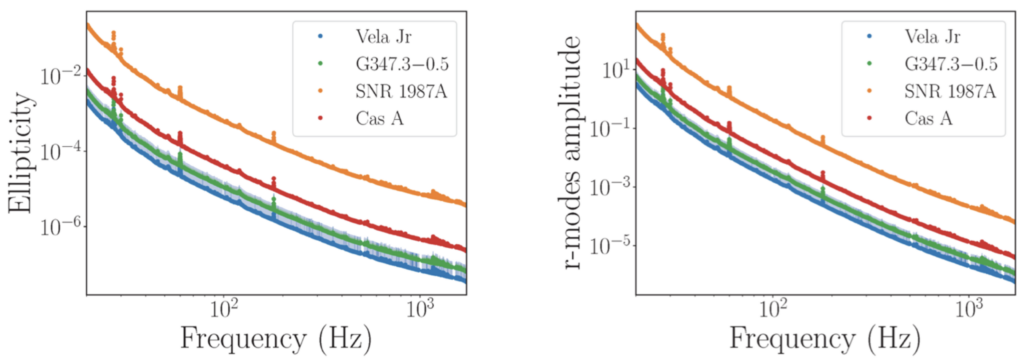
Figure 2: The 95% upper limits on NS ellipticity ε (left) and r-mode (right) for a few of the analyses and targets in the paper. The horizontal axis is the frequency at which we would detect a gravitational wave signal; the vertical axis is the 95% upper limit on the ellipticity (left)/r-mode (right). The blue (Vela Jr), green (G347.3-0.5), orange (SNR 1987A), and red (Cas A) curves show the minimum possible ellipticity (left plot) or amplitude (right plot) we could detect. This is an upper limit on how elliptic or strong r-modes in the NS could be. If the NS was more elliptical than this, we would have likely detected it. And if the r-modes were stronger than this, we would have observed them. For this plot, we chose the results from the fifth, cross-correlation-based pipeline (described above), which is new since the O3a search and is applied to the youngest SNR 1987A.
Triaxial neutron stars aren’t the only way a NS could generate CWs. Stellar rotation can also drive CWs through r-mode oscillations within the NS, with the scale of the oscillations parameterized by the amplitude α. The theoretical upper limit on the scale of the oscillations is α < 10-3. A limit on the strain from an elliptic NS can be converted into a limit on α, as we do in Figure 2 (right plot). The vertical axis is our 95% upper limit on α and the horizontal axis is the gravitational wave frequency (in Hz).
In summary, we don’t see a CW signal from the SN 1987A remnant, nor from any of the other remnants we explored. However the five different complementary search methods applied to the O4a data allowed us to set the strongest limits so far on how loud CWs could be, improving on our previous O3a results and pushing our sensitivity to CWs from young NSs to a new level. Our tightest limit was found for the nearby famous supernova remnant Vela Jr, which helps us learn how bumpy the NSs are and how strong some types of internal waves (or r-modes) can be. Those bumps (for Vela Jr) must be smaller than about one part in ten million, and the r-modes smaller than about one part in one hundred thousand at frequencies above 400 Hz. These results are the most sensitive broadband frequency searches so far for CWs from supernova remnants.
As data collection continues and our methods and sensitivity improve, the probability of making the first detection increases. Until then, we will continue to constrain physical models based on non-detections and push to increase further the sensitivity of our searches.
Find out more
- Visit our websites:
- Read a free preprint of the full scientific article here or on arxiv
- Read an introduction to continuous gravitational waves here.
Back to the overview of science summaries.