
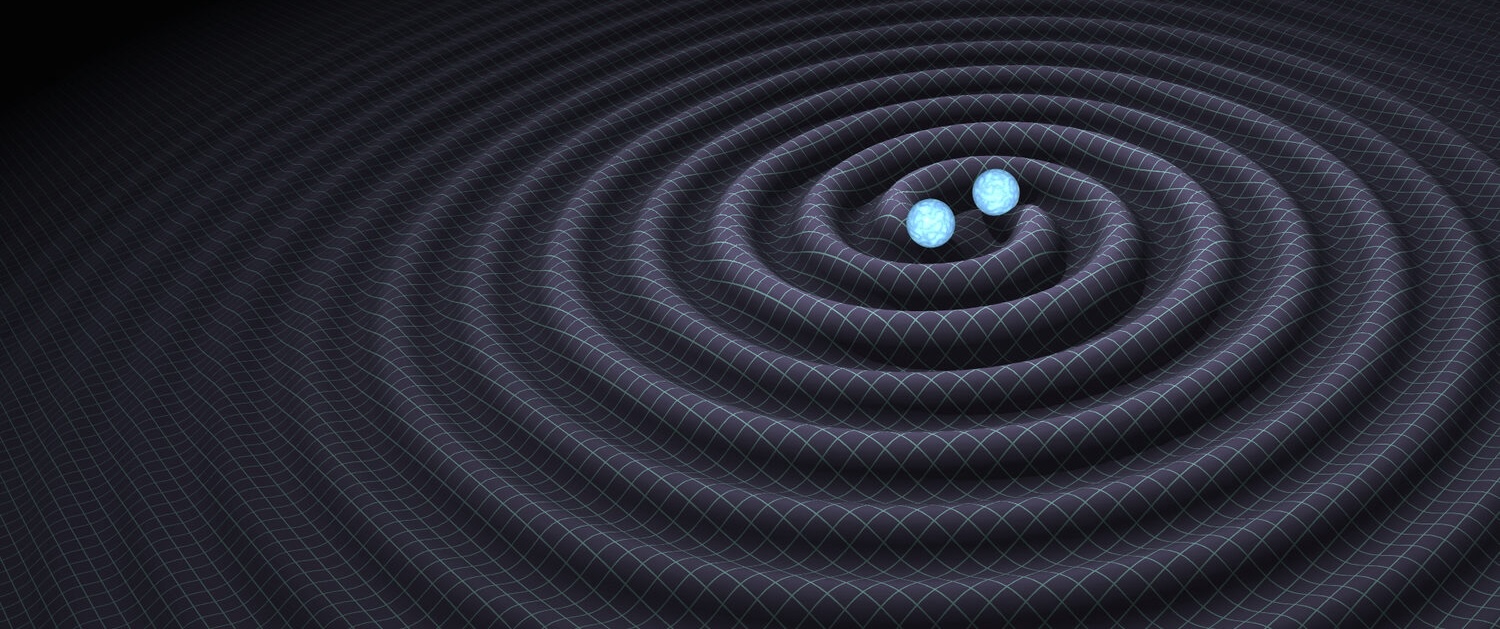
Gravitational waves provide a powerful way to explore the building blocks of our Universe that are hard or impossible to probe via other experiments. Physicists know that our best explanation for how particles interact with one another – known as the Standard Model – is incomplete, and many promising theories exist which propose modifications or extensions to the Standard Model to better explain our observations. In this study, the LIGO-Virgo-KAGRA Collaboration used observations of binary black hole mergers to investigate the properties of ultralight bosons: particles which exist in some proposed extensions to the Standard Model and which could help explain unresolved questions in particle physics and cosmology, including the nature of dark matter.
We combined two complementary approaches: a direct search for long-lived gravitational wave signals from clouds of vector bosons surrounding newly formed black holes and an indirect search based on the spins of merging black holes, both of which are based on a process known as black hole superradiance. Although no evidence for ultralight bosons was found, our results place more robust (i.e. based on fewer assumptions) and stronger (i.e. with higher confidence) constraints on the masses of both scalar and vector bosons, further narrowing the parameter space in which these particles could exist.
What is black hole superradiance?
Ultralight bosons are hypothetical particles predicted by many theories that extend the Standard Model of particle physics. They are extraordinarily light, many orders of magnitude lighter than known particles, and are among the leading candidates for dark matter. In this study, we consider both scalar bosons (spin 0) and vector bosons (spin 1). If such particles exist, they can interact with rotating black holes through a process known as black hole superradiance. In this process, a black hole transfers part of its rotational energy to the bosonic field, causing the field to grow exponentially and form a cloud of particles around the black hole.
As the boson cloud grows (see Figure 1), it extracts angular momentum from the black hole, causing the black hole to spin down – i.e. to slowly reduce its rotation speed. The cloud can also emit long-lasting gravitational waves (GWs) that are nearly monochromatic (i.e. with a single frequency). These effects provide two complementary ways to search for ultralight bosons: directly through GWs emitted by boson clouds and indirectly through measurements of black hole spins.
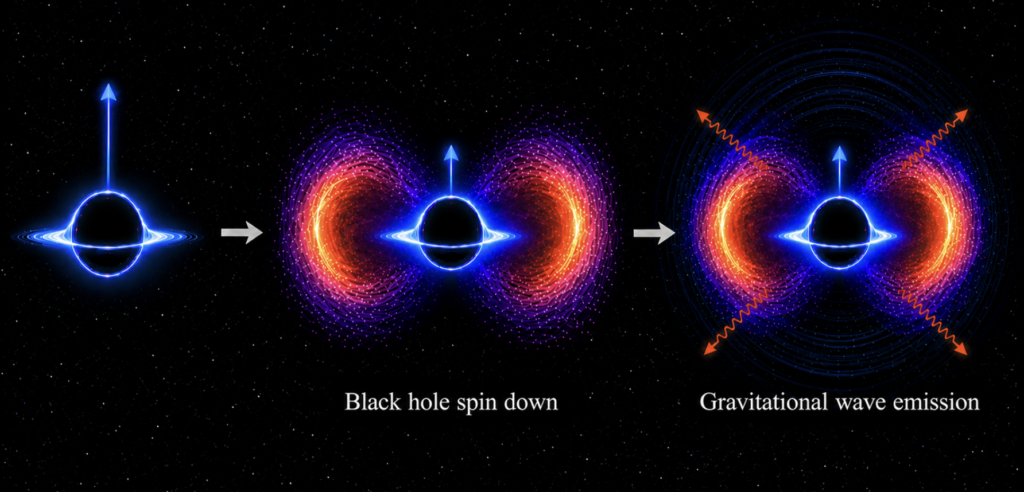
Figure 1: Schematic representation of the formation and evolution of a boson cloud around a rotating black hole. In the growth phase, superradiance extracts rotational energy from the black hole, amplifying the boson cloud and spinning down the black hole. In the subsequent and much longer GW emission phase, the boson cloud slowly depletes by emitting continuous GWs.
How do we look for them?
We used two complementary approaches to search for the effects of ultralight bosons in GW observations from the LIGO-Virgo-KAGRA (LVK) collaboration. First, we searched for long-duration GW signals from vector boson clouds surrounding the remnants of binary black hole mergers. We focused on vector bosons because they are expected to produce stronger GW signals than scalar bosons, making them more accessible to our current GW detectors. These signals are expected to be nearly monochromatic and can persist for hours to months after a black hole merger, making newly formed black holes promising targets.
We analyzed data following the mergers GW250114 and GW250207 using a technique known as a Hidden Markov Model, which is designed to track weak signals whose frequency evolves over time. These events were selected because their remnant black holes are massive, rapidly spinning, and relatively nearby, making them promising hosts for vector-boson clouds detectable with our search. In addition, they were chosen because the merger signals were exceptionally loud, allowing their properties to be measured with sufficient precision to enable accurate modeling of the expected GW signals.
Second, we carried out an analysis using measurements of rapidly spinning black holes observed in binary mergers. If ultralight bosons existed with certain masses that correspond with the masses of these black holes, superradiance would efficiently extract angular momentum from the black holes and reduce their spins. The observation of rapidly spinning component black holes in binary mergers can therefore rule out bosons with masses which, if such bosons did exist, would have already resulted in significant spin-down of these black holes . We applied this approach to the high-spin merger events GW240515_005301, GW241113_163507, and GW241225_082815, allowing us to place complementary constraints on both scalar and vector bosons.
What did we find?
Using the directed search for gravitational waves from vector boson clouds around merger-remnant black holes, we found no evidence for a signal. We therefore identified the range of vector boson masses that would likely have produced detectable GWs but were not observed. This allowed us to exclude vector boson masses in the range [2.80, 3.95] × 10-13 eV (where 1 eV, or electronvolt, corresponds to a mass of about 1.8 × 10-36 kg) with greater than 90% confidence. Our results are shown in Figure 2. Compared to the first LVK directed search for vector boson clouds using O4a data, our analysis achieves substantially stronger constraints.
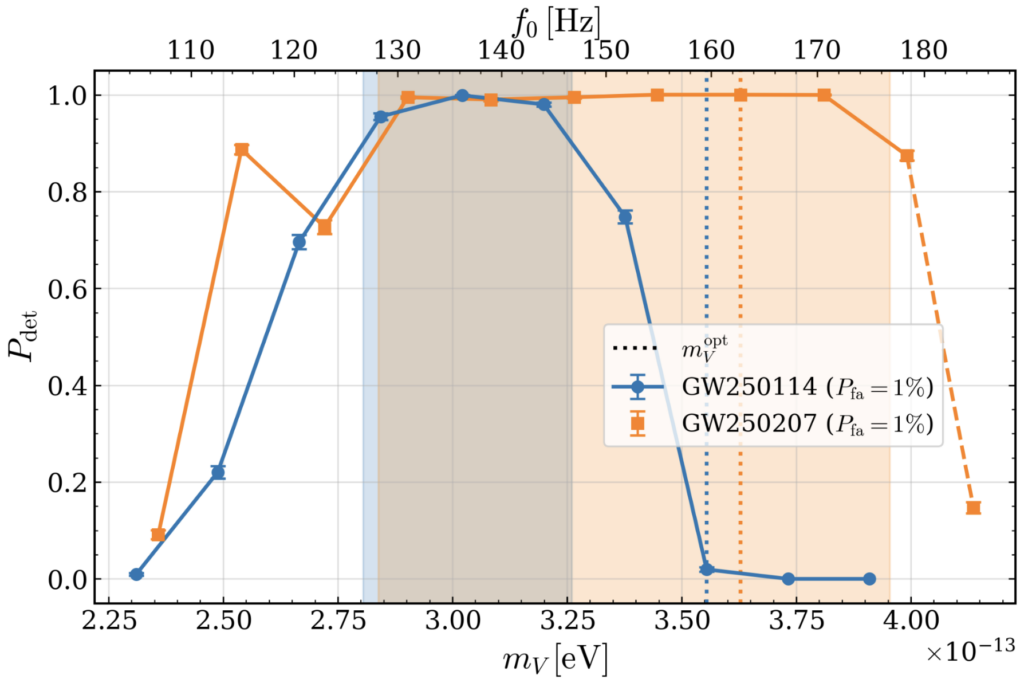
Figure 2 (Figure 3 in our paper): The estimated confidence (Pdet) with which we can disfavor the existence of the vector bosons with a mass given by the value on the bottom horizontal axis, given that the searches targeting the remnant black holes from GW250114 (blue) and GW250207 (orange) did not detect any GW emission. The top horizontal axis shows the corresponding frequency at which each boson mass would emit GWs. The shaded region indicates the range of vector boson masses disfavoured with 90% confidence.
Those stronger constraints are largely due to the properties of the merger events analyzed in this study. The black hole mergers GW250114 and GW250207 were both relatively nearby and detected with high signal-to-noise ratios, making them particularly favorable targets for this search. Together, these factors improved our ability to detect GW emission from vector boson clouds and hence enabled significantly higher-confidence exclusions of vector boson masses based on the non-detection of GW emission.
Our LVK spin measurements provide an independent probe of ultralight bosons. We found that the high spins observed in GW240515_005301, GW241113_163507, and GW241225_082815 are incompatible with efficient superradiant spin-down for certain boson masses. Assuming conservative black-hole lifetimes of at least 100,000 years, the measured spins allow us to exclude scalar boson masses in the range [1.39,6.94] × 10-13 eV and vector boson masses in the range [0.32,14.4] × 10-13 eV at 90% confidence (see Figure 3). These exclusions extend over a broader mass range than the directed search and provide a complementary test of the ultralight-boson hypothesis.
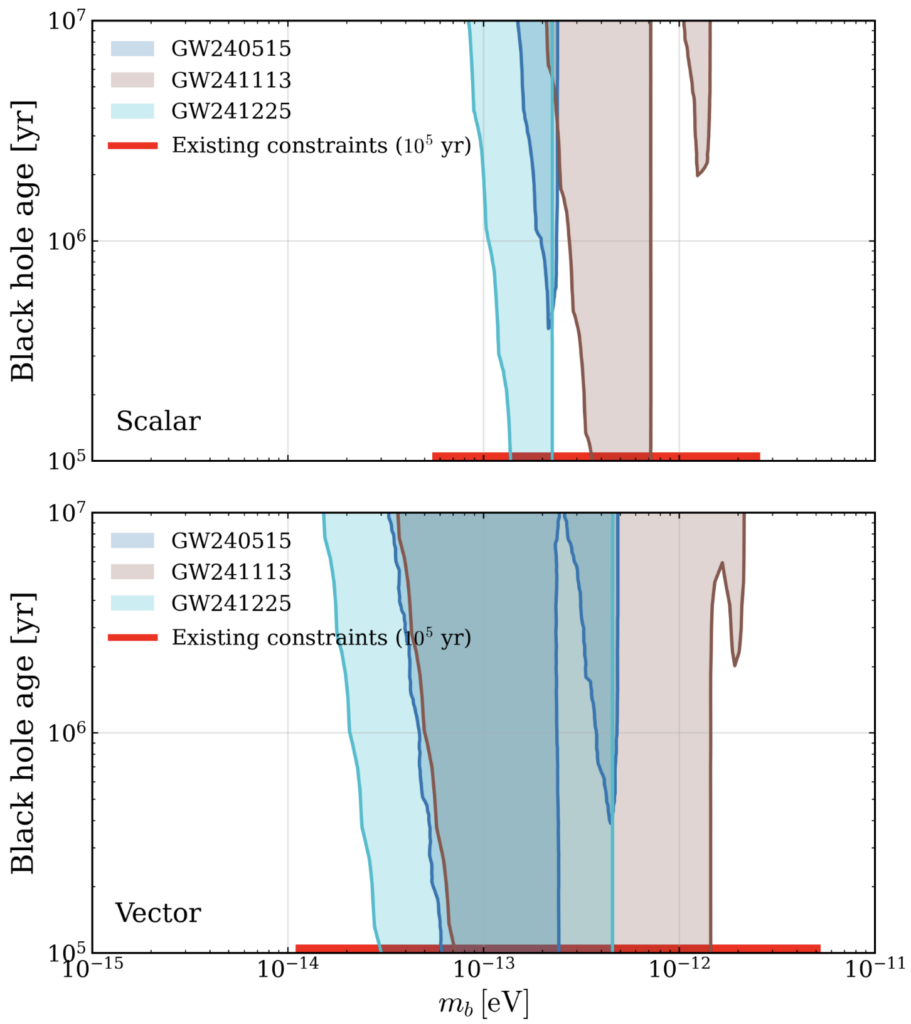
Figure 3 (Figure 4 in our paper): Regions of ultralight scalar (upper panel) and vector (lower panel) boson masses excluded by observations of the rapidly spinning black holes observed in the GW events GW240515_005301, GW241113_163507, and GW241225_082815. The shaded areas indicate boson masses that are incompatible, at the 90% confidence level, with the observed black hole spins for a given assumed black hole age.
Why is this important?
The absence of a detected signal does not mean that ultralight bosons do not exist. Instead, our results show that these particles are increasingly unlikely to exist within specific mass ranges that would have produced observable effects in our GW data. By combining a direct search for GWs from vector boson clouds with independent constraints from highly spinning black holes, this study places some of the strongest GW limits to date on ultralight vector bosons.
As GW detectors become more sensitive and the number of observed black hole mergers continues to grow, future searches will probe an even larger fraction of the ultralight-boson parameter space. These observations may eventually reveal a direct signature of new particles, or they may continue to narrow the range of viable theories. Either outcome would provide valuable insight into the fundamental nature of dark matter.
More broadly, this work demonstrates how black holes and GW observations can be used as powerful laboratories for particle physics, allowing us to test ideas that are difficult or impossible to study in terrestrial experiments.
Glossary
Bosons – Class of elementary particles. Bosons do not obey the Pauli exclusion principle that is obeyed by fermions (another class of elementary particles, such as electrons). This property allows many bosons to occupy the same quantum state at the same time and form macroscopic objects such as the boson clouds we consider.
eV: The abbreviation for electronvolt, a unit of energy commonly used in atomic and particle physics. Because of the relation between energy and mass established by Einstein, E = mc2, masses of particles can be given in units of energy divided by the square of the speed of light, i.e., eV/c2. For example, the mass of the electron is 5.11 ⨉ 105 eV/c2 while the mass of the neutrino, the lightest massive particle currently known, is less than 0.120 eV/c2. When the natural unit system is used (which sets c = 1), masses are expressed in eV.
Superradiance – A process in which particles extract rotational energy from a spinning massive object. In the case of boson clouds, a bosonic field in the vicinity of a rotating black hole can be amplified through superradiant scattering.
Vector boson – A class of particles that has a spin of 1. For example, a photon is a vector boson, and it carries electromagnetic force. Here we consider a vector boson and its force which are not included in the standard model of particle physics.
Find out more
- Visit our websites:
- Read a free preprint of the full scientific article:
https://dcc.ligo.org/P2600218/public/ or on arxiv: https://arxiv.org/abs/2608.11620 - Read this science summary about our previous (O3) search for scalar boson clouds around spinning black holes: https://ligo.org/science-summaries/O3BosonClouds/
Back to the overview of science summaries.