
Summary
We have carried out the most sensitive search to date for continuous gravitational waves (CWs) from the low-mass X-ray binary Scorpius X-1. For the first time, if Scorpius X-1 is emitting gravitational waves (GWs) as loud as predicted by the “spin-torque balance” model, the Laser Interferometer Gravitational Wave Observatory (LIGO) detectors would be able to pick up this signal across the range of frequencies between 50 and 200 Hz.
Using data from the first part of the fourth LIGO-Virgo-KAGRA (LVK) observing run (O4a), we searched over the 25–200 Hz frequency band using a cross-correlation method. By analyzing the data from the perspective of the neutron star (NS) member of the binary system, we were able to account for the binary’s orbital motion, allowing our analysis to be coherent over a longer time. A few interesting candidate signals were identified with a signal-to-noise-ratio (SNR) that exceeded our detection threshold; these candidates were re-analyzed with a longer coherence time to see if their behaviour remained consistent with a real signal. However, none of the candidates provided sufficient evidence to claim a GW detection.
What are we looking for?
Searches for GWs from a specific NS are like being able to see a band playing music but being too far away to hear them. Instead, you have a highly sensitive instrument that can detect tiny oscillations in the air produced by the band, and by analyzing these oscillations you try to predict the music the band is playing. Continuous GWs are significantly weaker in amplitude than the (many) GW signals that have already been detected from the inspiral and merger of binaries of compact objects such as black holes or NSs. However, unlike these binary merger signals, which are short-lived, CW signals are emitted continuously over long timescales. Therefore, searches for CWs can combine data over long stretches (such as an entire observing run) to accumulate signal over time and increase the chance of detection. While a compact binary merger produces a “chirp” signal that rapidly increases in both frequency and amplitude, CWs are “quasi-monochromatic” signals – meaning that they maintain a nearly constant frequency over long timescales.
Dense NSs, spinning at incredible rates of up to hundreds of rotations every second, are the most likely sources of CWs. Any slight asymmetry in the distribution of the mass of the NS will generate GWs at a frequency which is twice the rotation frequency of the NS. When these waves reach our detectors on Earth, the frequency will be changed (known as the Doppler shift) due to the motion of the detectors as the Earth rotates and moves through its orbit, as well as any time-varying motion of the NS itself.
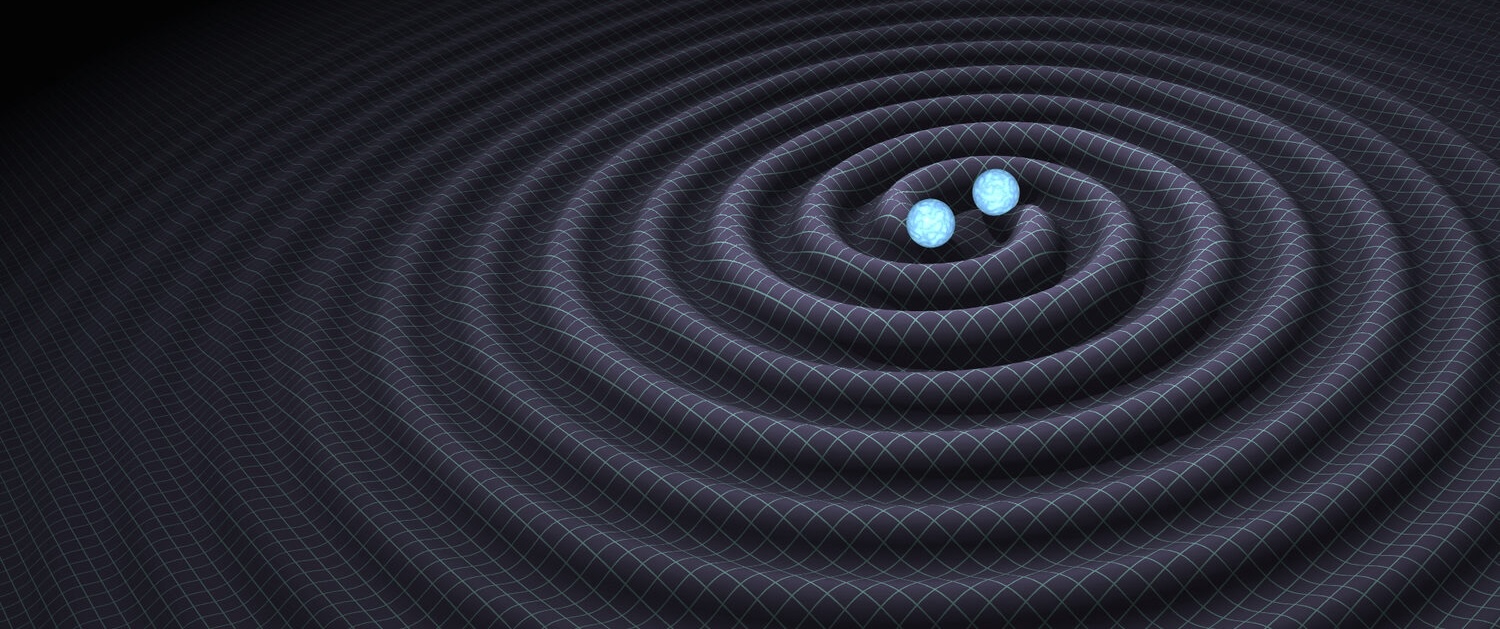
The most promising known source of CWs is the Low-mass X-ray binary (LMXB), Scorpius X-1 (Sco X-1). An LMXB (see Figure 1) is a system consisting of a compact object in a binary orbit with a lower mass companion star. Sco X-1 is an LMXB in our galaxy which is the brightest persistent X-ray source (other than the Sun) that we observe, and is relatively close by at only 9000 light years away. In an LMXB, the NS pulls gaseous matter from the companion star in a process known as accretion. The accreted material creates a “bump” on the surface of the NS, causing an asymmetry in its mass distribution which generates CWs as the NS rotates.

Figure 1: An artist’s impression of a low-mass X-ray binary like Scorpius X-1. Credit: Gabriel Pérez Díaz, SMM (IAC)
Accretion of matter onto the NS also influences its rotation. Accretion can “spin up” the NS, increasing its rotation speed, while GWs, along with other forces such as the interaction of the NS’s magnetic field with its environment, can “spin it down”. When the torques, or turning forces, due to spinup and spindown cancel each other, the NS spin remains constant. The scenario in which this constant spin is maintained by accretion and GW alone is known as “torque balance”, and gives an optimistic (because it neglects other contributions to the spindown) estimate of the expected GW signal strength. The mass transferred from the donor star to Sco X-1 is not constant. Because the spin-up of Sco X-1 is driven by accretion torque, accretion rate variation will lead the NS spin frequency to fluctuate stochastically over time. This is known as spin wandering. Over a long observation, spin wandering causes the GW signal to drift away from its expected phase evolution, leading to phase mismatch and a loss of signal-to-noise-ratio (SNR).
The accretion onto the NS also produces X-rays which can be observed with X-ray telescopes to estimate the accretion rate. Observations of Sco X-1 over a wide range of electromagnetic frequencies from radio to X-rays have given information about its sky position and the parameters of the NS orbit. This information is essential for determining the possible GW signals, making our search an example of multi-messenger astronomy. To date, many Sco X-1 searches have already been carried out using techniques known as the radiometer and Viterbi method, as well as the cross-correlation method that is used in this work.
How did we search?
The GW signals are “Doppler modulated” by the daily rotation of the Earth and yearly orbital motion of the Earth around the Sun, as well as the motion of Sco X-1 around the center of mass of its binary system (see Figure 2). This effect is similar to a fire truck’s siren, that sounds higher pitched while approaching us and lower pitched while receding. We use a technique called resampling to transform the data from the reference frame of the detector to the reference frame in which the NS is at rest, analogous to shifting our perspective from standing outside the fire truck as it drives by to riding inside the truck, so that we hear the siren without any shift in pitch. This correction removes the Doppler shifts caused by both the Earth’s motion and the orbital motion of the binary, so the signal becomes monochromatic.
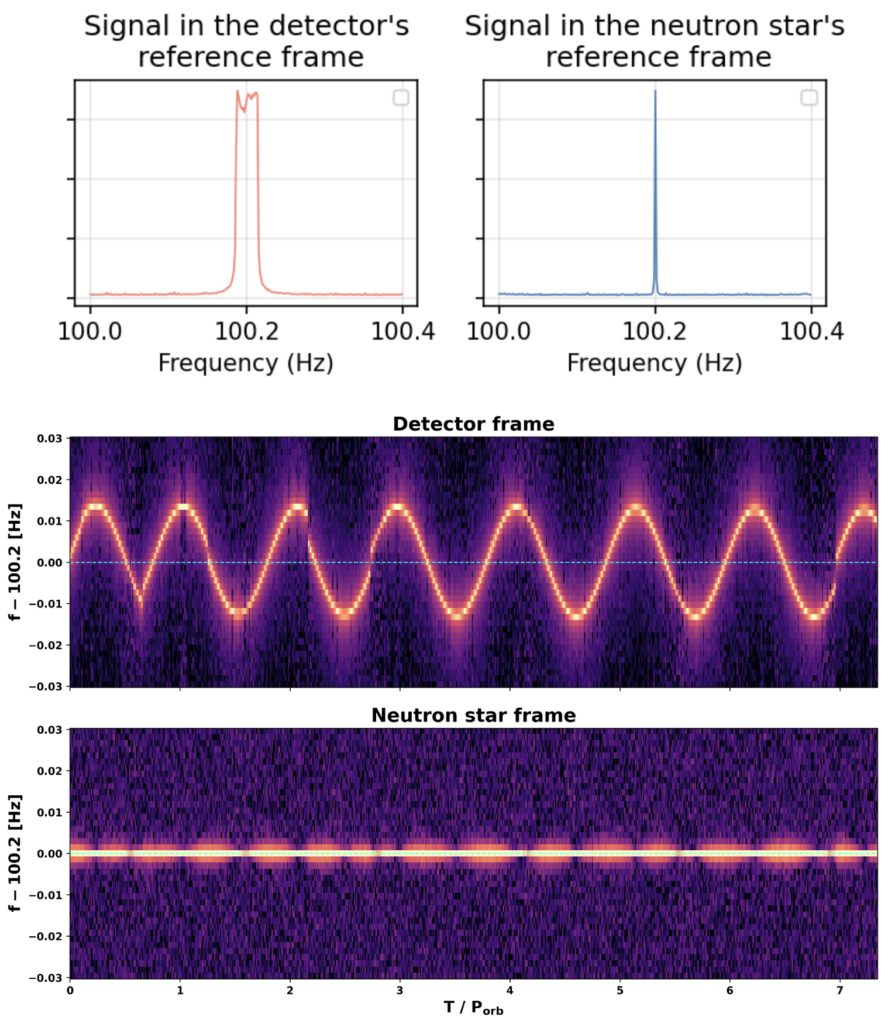
Figure 2: The top panels show how the power of the observed GW signal is distributed across different frequencies in the detector’s reference frame (left) and neutron star’s reference frame (right). In the right panel, correcting for orbital motion transforms the Doppler-modulated signal into a constant frequency. (An artificially high amplitude is shown for illustrative purposes.) The middle and bottom panels show the corresponding spectrograms, i.e. graphs of the signal’s variation with time: the detector-frame signal oscillates sinusoidally due to the binary’s orbital motion, while in the neutron star frame it is transformed to become constant at frequency f=100.2 Hz. The additional Doppler modulation due to the Earth’s orbit around the Sun is not visible because it is much smaller than Sco X-1’s orbital modulation.
The resampling pipeline uses the same cross-correlation search, with the only difference being that the data are time-translated from the detector’s reference frame to the rest frame of the NS before the search is performed.
To better understand the cross-correlation search, imagine a clarinet player walking back-and-forth while playing a particular musical note. Because of the clarinet player’s motion, the pitch will sound slightly sharp or flat over time. Suppose now two listeners at different locations record the sound of the clarinet. From visual observation alone they can estimate the player’s velocity and the time period of the back-and-forth motion. By comparing what each listener hears, they can also track how the pitch of the musical note shifts over time and correct it for the Doppler shift due to the player’s motion. The better the match between the frequencies heard by the two listeners, the more accurately they can recover the true frequency of the note being played.
Similarly, the cross-correlation method looks for correlations between data segments taken at different times and/or in different detectors, using a model for the GW waveform produced by a rotating neutron star to predict the correlations expected. To construct this model waveform requires knowledge of the properties of the binary system such as the true GW signal frequency, sky location and orbital parameters. For Sco X-1, the frequency is unknown, while the sky position is well determined by electromagnetic observations. The orbital parameters are also known, although somewhat imprecisely, so we need to perform the search using many possible sets of parameters, including the signal frequency, period, phase and size of the orbit. Our search only considers correlations between data separated by no more than an adjustable time offset called the coherence time.
We analyzed data from the first part of the fourth LVK observing run (O4a), which ran from May 2023 to January 2024. Excluding times when one or both detectors was not taking high-quality, usable data, this amounted to about 159 days’ worth of data from the LIGO Hanford detector and 163 days from the LIGO Livingston detector. The coherence time was set to 24 hrs.
What did we learn?
The result of our search is a calculated SNR for each combination of parameter values considered. If the SNR for any such combination is higher than one would expect from data that contains only noise, we “follow up” this candidate combination as a possible detection. We do this by re-analyzing the data but with a longer coherence time and over a narrow grid of parameter-space points around the candidate combination of values. If the SNR increases, we repeat the process, adopting an even longer coherence time. We also perform this analysis on candidates that arise from simulated signals, i.e., where we ‘inject’ a CW signal into noise. Figure 3 shows that none of the candidates identified in our search increased their SNRs in the same way as our simulated injections, as a true signal would.
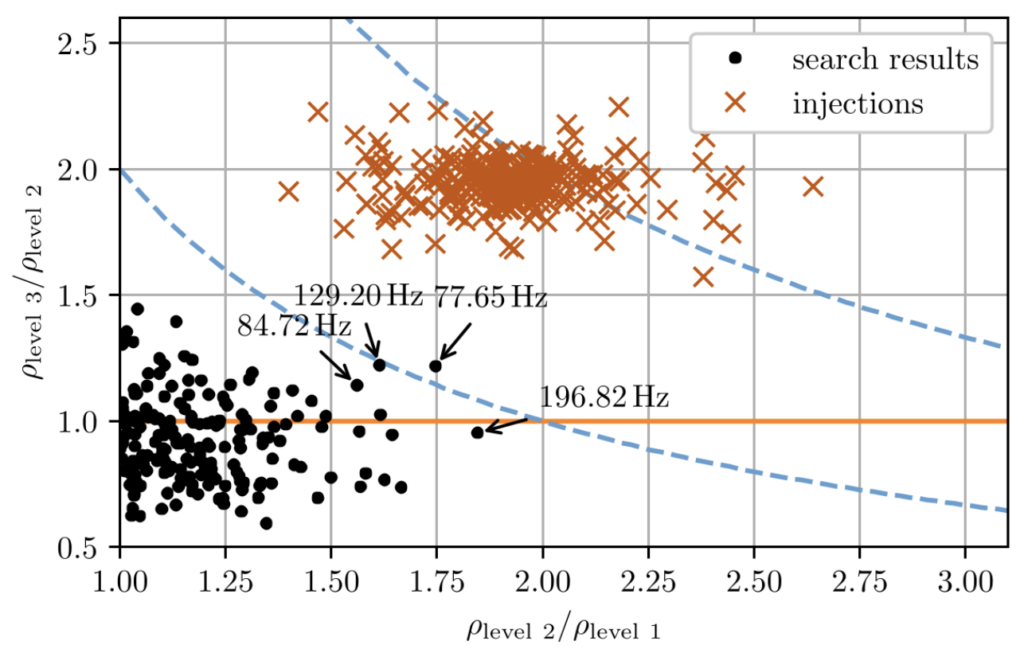
Figure 3 (Fig. 4 from our paper): The results of follow-up analyses of potential signals from our search. The horizontal axis shows the ratio of signal-to-noise ratios (SNRs) before and after a quadrupling of the coherence time in the cross-correlation, which should theoretically double the SNR. The vertical axis shows the ratio of SNRs before and after a second quadrupling, which should therefore theoretically increase the original SNR by a factor of four. The blue dashed lines show constant values of the ratio of SNRs before and after the two quadruplings taken together, with the lower dashed line equal to 2 and the upper dashed line equal to 4. The red crosses show simulated injected signals, whose SNRs increase with each increase in coherence time, as expected. In comparison, the SNRs of the search candidates (black dots) do not follow the behavior expected of a true signal. However, a possible signal candidate is indicated at a frequency of 129.20 Hz; this candidate does show an increasing SNR with quadrupling, though not as strongly as expected for an ideal signal. The frequencies of three other such possible signal candidates are also labeled in the figure.
Since our search did not reveal a detection, we set upper limits on the strength of GWs from Sco X-1 as a function of frequency (Figure 4). The upper limits are chosen such that, if a signal were present with that amplitude or larger, our search would have produced an SNR as high, or higher, than we observed at that frequency, with a probability of 95%. These results represent the most sensitive constraints on the strength of Sco X-1’s GW emission to date, and probe amplitudes that are predicted to be realistic by models of the torque balance scenario. Figure 5 shows the corresponding upper limits on the ellipticity of the NS (which roughly measures how far it is from spherical symmetry) and its r-mode amplitude (which measures how large the fluid oscillation velocity is compared to the NS rotational velocity) as a function of frequency.
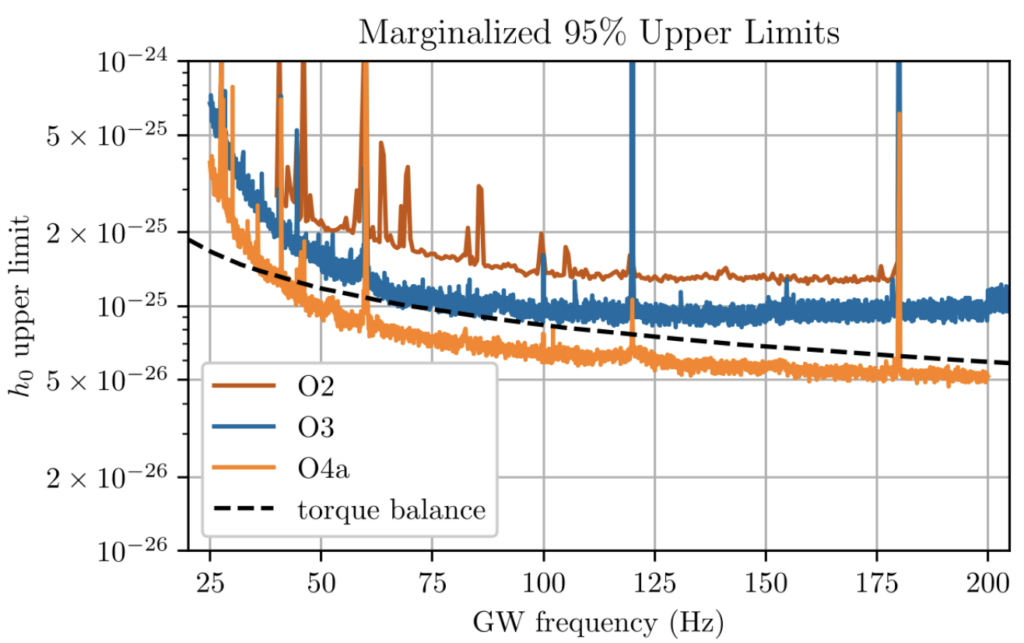
Figure 4 (adapted from Fig. 5 of our paper): how the 95% upper limit set on the GW amplitude h0 by the O4a cross-correlation search varies with GW frequency. Also shown are the results of cross-correlation searches from previous observing runs O2 and O3. For the first time, the O4a upper limits beat the torque balance limit expected across a broad frequency range of 50–200 Hz, marginalized (i.e., averaged) over the unknown inclination angle of the NS spin.
With improved sensitivity in future Advanced LIGO-Virgo-KAGRA observing runs, we expect to be able to search for even weaker signals from Sco X-1. In a more realistic situation where other spindown mechanisms are relevant in addition to GWs, the GW strength is expected to be lower than the nominal torque balance amplitude. Thus, improved sensitivity in future observing runs means that we will be able to probe more realistic scenarios and hence potentially detect GWs from Sco X-1.
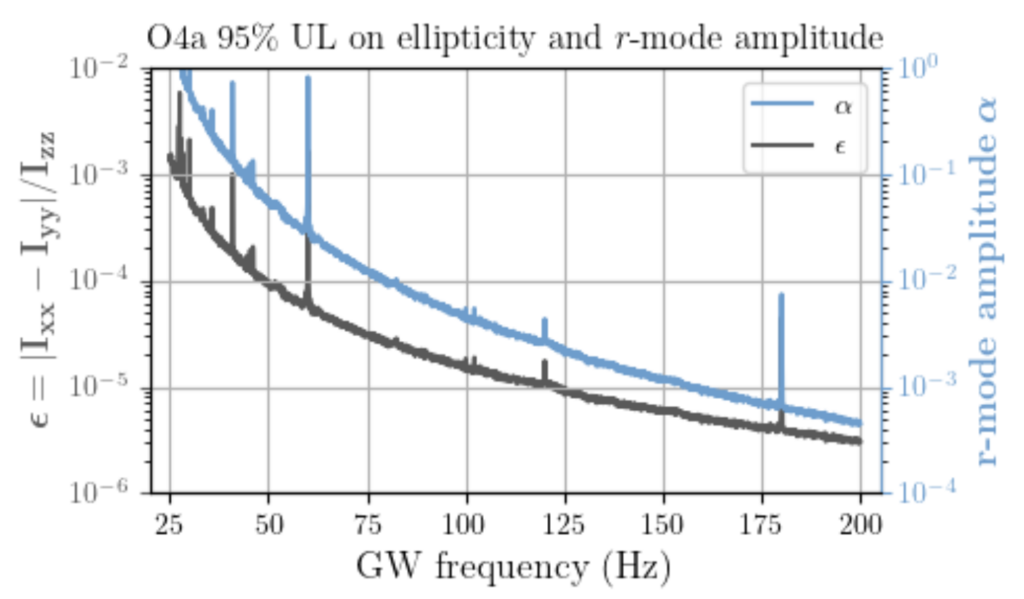
Figure 5 (Fig. 7 of our paper): how the 95% upper limit set on the ellipticity and r-mode amplitude of the NS in Sco X-1 varies with GW frequency, derived from the upper limits on GW amplitude shown in Figure 4. At higher frequency our search becomes sensitive to the maximum ellipticity that the NS crust can support. For r-mode amplitudes, the upper limits are well above the predicted r-mode saturation amplitude.
Another way to learn more about GW signals is through electromagnetic observations. If pulsations or thermonuclear bursts are ever detected electromagnetically from Sco X-1, GW astronomers may be able to better constrain the frequency of the emitted GW signals. Furthermore, by observing its X-ray variability, we can better model and predict changes in the accretion process of Sco X-1 which may also help us understand and track the spin wandering of the NS, i.e., changes that may cause the NS to spin up or spin down.
Find out more
- Visit our websites:
- Freely readable preprint of the paper describing the details of the full analysis and results: Sub-Torque-Balance Upper Limits on Continuous Gravitational Waves from Scorpius X-1 on Arxiv: https://arxiv.org/abs/2607.07765
- Freely readable preprints of the papers describing our method in more detail:
Back to the overview of science summaries.