
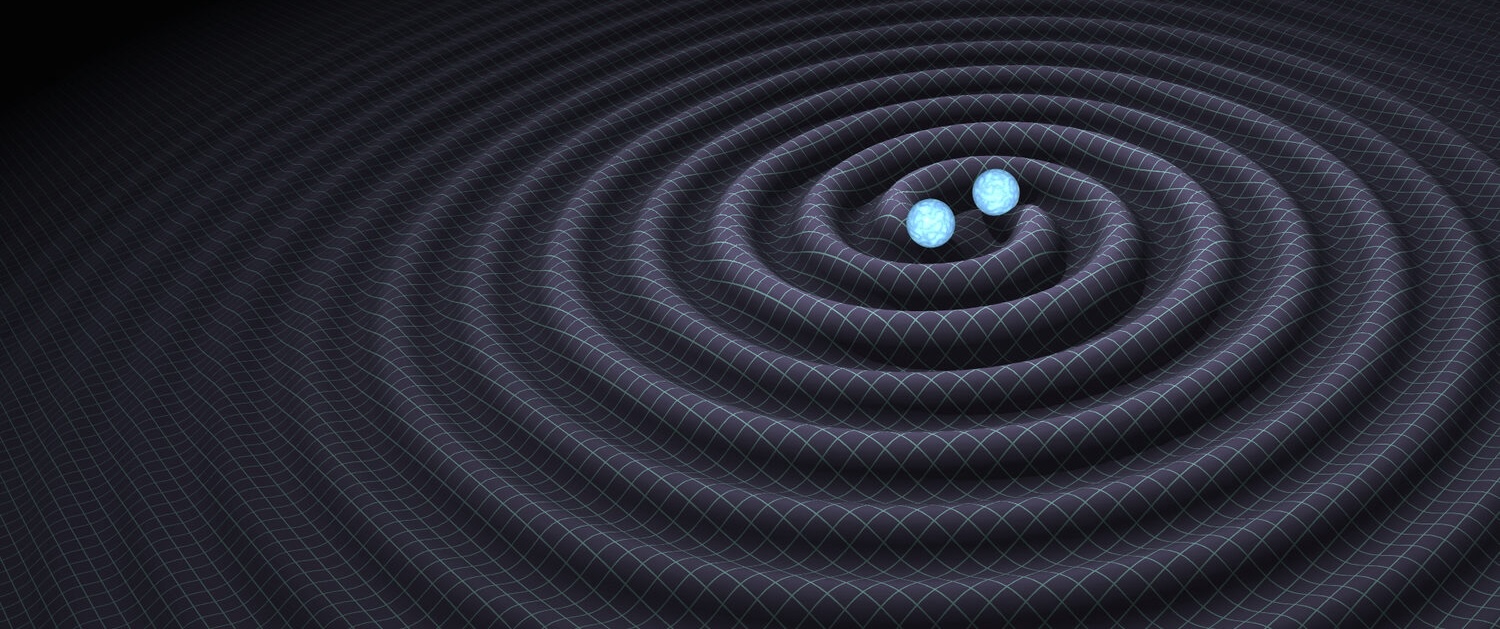
The LIGO, Virgo, and KAGRA collaborations have publicly released a new dataset from the second segment of their fourth observing run (O4b), covering gravitational-wave (GW) observations from April 10, 2024, to January 28, 2025. In O4b, Virgo joined the two LIGO observatories (Hanford and Livingston), allowing this data release to include strain data from all three instruments, compared to the first segment of O4 when only LIGO collected data. KAGRA data are not yet sensitive enough to be used in primary analyses.
Making GW data publicly available
Public data releases enable broad participation in science. Past data releases from GW observatories have been cited in over 1100 scientific publications, across diverse research topics that range from nuclear physics and the origin of heavy elements like gold to the expansion of the universe and testing Einstein’s general relativity. Teachers, students, and citizen scientists also use these resources for a wide range of investigations and educational activities.
This release includes GW measurements recorded with unprecedented precision. As shown in Figure 1, which tracks the binary neutron star range (a standard measure of interferometer sensitivity), the LIGO observatories achieved a slight increase in sensitivity during O4b. At peak performance, LIGO could detect binary neutron star mergers up to approximately 165 megaparsecs (Mpc) (or 540 million light-years) away from Earth, with Virgo operating at a sensitivity of around 50 Mpc.1
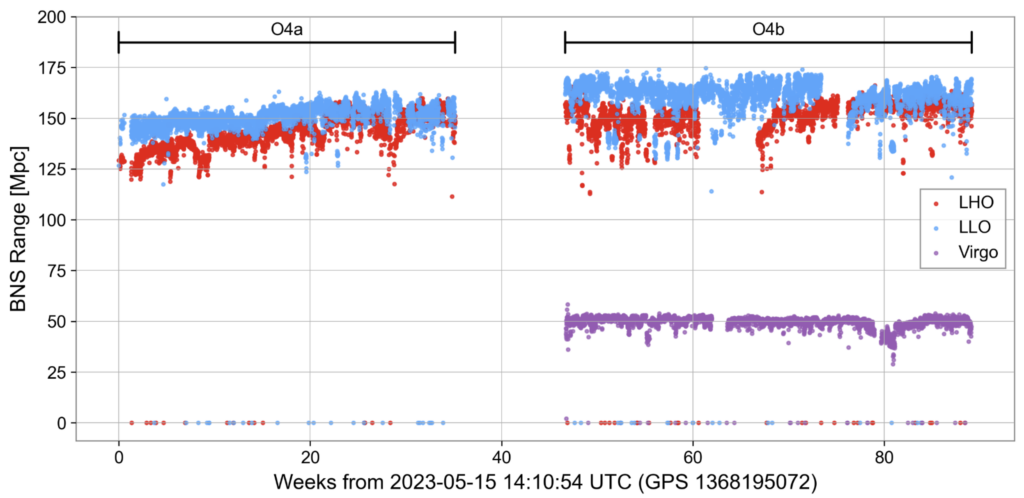
Figure 1: The binary neutron star observable range (vertical axis), as a function of time during the O4a and O4b runs (horizontal axis). The instruments were capable of detecting binary neutron star mergers from distances as far as 165 Mpc (540 million light-years) from Earth. Additional data segments were included in both the O4a and O4b releases that were related to GW searches from supernovae: O4a covers data starting from May 15, 2023 for supernova 2023ixf, while O4b covers data starting from April 6, 2024 for supernova 2024ggi.
The data are available through the Gravitational Wave Open Science Center (GWOSC), which also hosts past data releases for public access, and other distribution channels described in the paper. Figure 2 shows the homepage of the GWOSC website.
Figure 2: Homepage of the GWOSC website (https://gwosc.org/). GWOSC makes available public gravitational-wave data along with software, tutorials, and documentation.
What’s included in a GW data release?
Key data products include two types of data files:
- Strain time-series data record tiny distortions in the detectors’ arm lengths that are the primary data product of the observatories. They include a mix of microscopic length changes due to passing gravitational waves and noise from local sources.
- Segment lists, available through the GWOSC Timeline app, record times when the observatories were operating, provide information about data quality, and include flags for simulated GW signal injections (artificially generated test signals deliberately added to detector data to test the detection pipelines).
The release includes documentation and multiple download methods, such as a web interface, an application programming interface (API), and curated Zenodo repositories.
Also included is the fifth version of the Gravitational Wave Transient Catalog (GWTC 5.0), which lists confident GW detections from O4b and earlier runs. Users can explore the catalog through the GWOSC Event Portal or programmatically via an API.
Additional datasets complement the release, such as strain data surrounding supernova 2024ggi and auxiliary channel sets used to identify periods when the data could be contaminated by spurious noise. Furthermore, GWOSC has recently started hosting community catalogs, making available discoveries of GW sources found in public data by researchers outside the LIGO/Virgo/KAGRA collaboration.
Exploring GW data
With this release, we intend to facilitate wide access to GW data and allow for the reproducibility of the analyses from the participating collaborations. A great way to get started is by attending an Open Data Workshop, available at learn.gwosc.org. If you make use of these data, don’t forget to acknowledge their use.
Find out more:
- Visit our websites:
- Gravitational-Wave Open Science Centre: gwosc.org
- The O4b Data Release: gwosc.org/O4/O4b/
- Open Data Workshop: learn.gwosc.org
- Read a free preprint of the full scientific article here
or on arXiv: https://arxiv.org/abs/2605.27090
1 It is worth noting that the detection range for binary black hole mergers is significantly greater, reaching several thousand Mpc. This is because black holes are much more massive than neutron stars, and when they merge, they create much stronger gravitational waves that are easier to “hear” from across the universe.
Back to the overview of science summaries.