
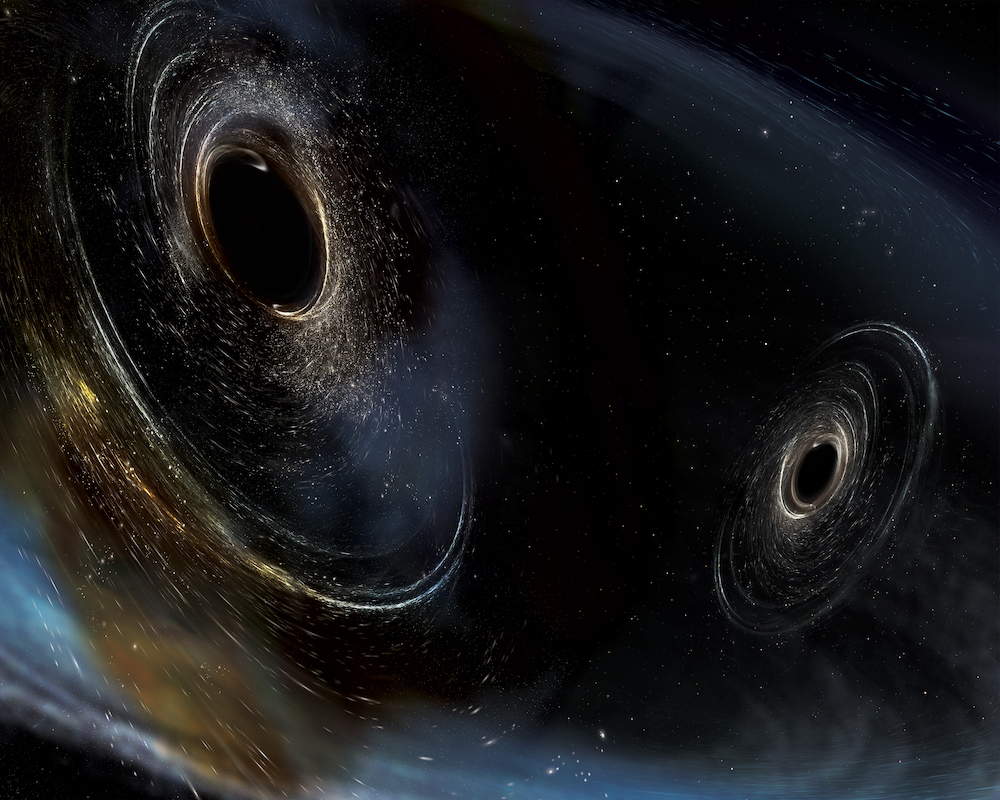
The LIGO-Virgo-KAGRA collaboration re-examined the validity of general relativity with an expanded dataset, including 42 new high-significance black hole mergers detected during the first part of the observing run O4a. With more gravitational-wave events observed, the tests became increasingly stringent.
Those tests are based on assessing the internal consistency of the theory across different stages of coalescence or searching for specific “distortions” of gravitational wave signals motivated by plausible violations of general relativity. Such deviations could arise during the generation and propagation of gravitational waves, or when the merging objects are not entirely black holes.
For all the events considered, the gravitational wave signals are described very well by general relativity. The final masses and spins, as inferred from the low- and high-frequency parts of the waveforms, are consistent with each other. No evidence was found for deviations from general relativity in either generation or propagation of gravitational waves encoded in the signals’ shape, placing tighter bounds on possible deviations from general relativity. There are also no signs of post-merger echoes, which would be expected if the remnant were not a black hole.
The results confirm that general relativity is consistent with gravitational wave observations. Combining the 42 newly tested events with earlier detections, even tighter constraints on possible deviations from general relativity were determined.
For further details see the corresponding science summary.