
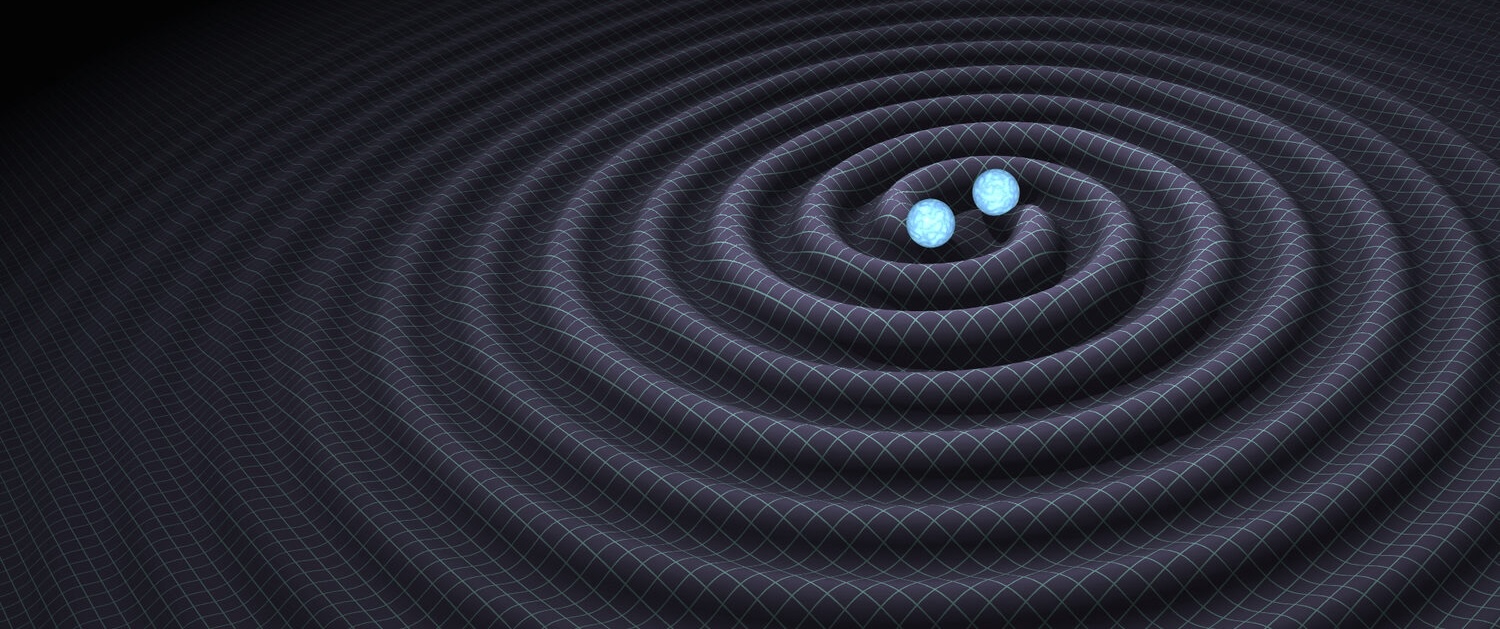
We present findings based on the population properties of 267 compact binary mergers reported in our latest Gravitational-Wave Transient Catalog, GWTC-5.0, which builds upon GWTC-4.0 and includes the latest data collected between 2024 April 10 to 2025 January 28. While individual merger events provide valuable insight, studying the population as a whole can offer a more complete picture of how compact binaries form, evolve, and merge.
Our Universe contains stars spanning a vast range of masses and evolutionary stages. Some stars are relatively small and can live for tens of billions of years. Others live fast and die young, burning through their nuclear fuel in only a few million years. These massive stars, with masses ranging from tens to even hundreds of times that of the Sun, leave behind compact remnants after their deaths. These compact remnants include neutron stars and black holes, which can sometimes form pairs that eventually merge. Such mergers produce gravitational waves (GWs), ripples in spacetime that have quickly become one of the primary tools for understanding the formation and evolution of compact astrophysical objects across cosmic history. Gravitational waves can travel across the Universe for billions of years, passing almost unaffected through intervening matter and galaxies before finally being detected on Earth.
As our detectors probe deeper into the Universe, studies of compact binary populations will provide an increasingly detailed view of how black holes and neutron stars behave and how they interact with each other. They also provide insights into the nature, evolution and death of the massive stars that shape the cosmic history of black holes and neutron stars. galaxies before finally being detected on Earth.
Methods
The compact binary mergers presented in this work span binary neutron stars (BNS), neutron star–black hole (NSBH) pairs, and binary black holes (BBH). Our paper paints a portrait of how these systems form, their properties and how they merge across cosmic time. They are drawn from the newly-published GWTC-5.0 catalog of GW detections, and include confident detections from the second part of LIGO-Virgo-KAGRA’s (LVK’s) fourth science observing run (O4b). Also, due to an update on the results from the first part of the observing run (O4a), our 267 candidates include two more events from GWTC-4.0 population analyses.
Inferring population properties requires a careful understanding of selection effects, a common challenge in observational astronomy. GW detectors are more sensitive to nearby, higher-mass mergers than to distant, lower-mass systems, and this bias must be properly accounted for in the analysis. GW signals from compact binaries are well described by general relativity and we use these predictions for understanding the signals under the assumption that the orbits are almost entirely circular.
Unlike electromagnetic signals such as radio emission, GWs are very weakly affected by intervening matter, allowing their selection effects to be modelled with high accuracy. To quantify these effects, we inject millions of synthetic GW signals with different masses, spins, and redshifts into real detector data, and measure the ability of our search pipelines to detect them. These measurements, in turn, allow us to ‘undo’ selection effects and construct the real population distribution of merging compact binaries. To account for other systematics due to, e.g., mismodeling the population, we validate and cross-check our results using different sets of models for the compact binary population.
Highlighted results
Mass distribution: The structure and features identified in the GWTC-4.0 analysis persist in the present study. Figure 1 (left panel) shows the black hole mass distribution which can be broadly described as a double power law with an overdensity at ~ 10 M⊙ (where the symbol M⊙ denotes Solar Masses) and a change in slope around 35 M⊙. Figure 1 (right panel) shows that black holes are more likely to pair with other black holes of comparable masses, a tendency that is even more pronounced for black holes with masses around 35 M⊙. As a rule of thumb, stars also like to form binaries with other stars of comparable mass, so the same preference for black holes is not unexpected.
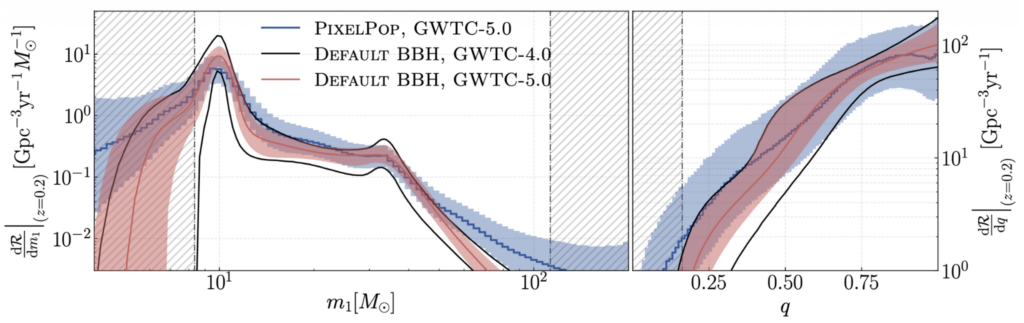
Figure 1 (Fig. 2 in our paper). Left panel: the distribution of the primary mass (i.e., the more massive component) in the binary black hole population. The GWTC-5.0 results (blue and red) retain the overall structure seen in GWTC-4.0 (solid black), with persistent features around 10 Mand 35 M. Right panel: the distribution of mass ratio, q, which probes how black holes pair with each other. A mass ratio of q = 1 indicates a black hole paired with a companion of the same mass.
Spins: The properties of astrophysical black holes are determined by their spins, in addition to their masses. These spins, either individually or in combination with masses, can encode information about their birth environments, formation channels, and evolutionary histories. We characterize black hole spins with the dimensionless spin parameter 𝛘 which is a number that lies in the range [0, 1]. A black hole with 𝛘 = 0 is not spinning at all, while a black hole with 𝛘 =1 is spinning as fast as theoretically possible according to general relativity. We find that while most black holes have small dimensionless spins (see Fig. 2), about 15% of them of them have large spins, 𝛘 ~ 0.7.
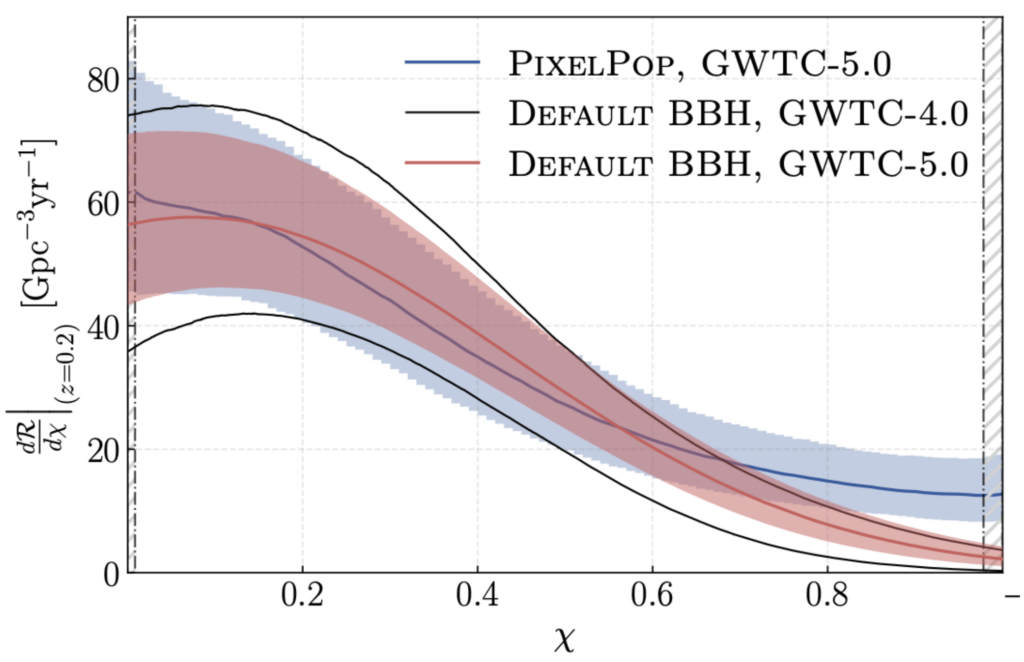
Figure 2 (adapted from Fig. 3 of our paper): The distribution of how fast individual black holes rotate. We denote this with the dimensionless spin magnitude that represents the fraction of the maximum spin that is allowed by general relativity. The GWTC-5.0 models (blue and red bands) are consistent with the previous GWTC-4.0 results (solid black lines) and preserve the overall distributional structure. Most black holes have small dimensionless spins, but a small fraction of them have large values.
Another useful way to study the spins of compact binaries is through the effective inspiral spin, 𝛘eff , which measures the alignment of the spins with the orbital angular momentum and is generally the spin parameter that is best measured with GWs. As with all our estimates, this is not characterized by a single number but by a probability distribution which tells us how likely different values of a physical variable are, given our data. Figure 3 shows the distribution of the effective spins and its shape can be a useful indicator of the black hole formation mechanism. We find that the distribution is asymmetric about zero with more binaries having positive effective spin (i.e. spins aligned with the orbital angular momentum) rather than negative (anti-aligned with the orbital angular momentum). Based on this asymmetry we confidently find that at least 6% of binary black holes must have been produced in formation channels that form preferentially aligned binaries, possibly due to effects like tides or interactions of black holes with stars.
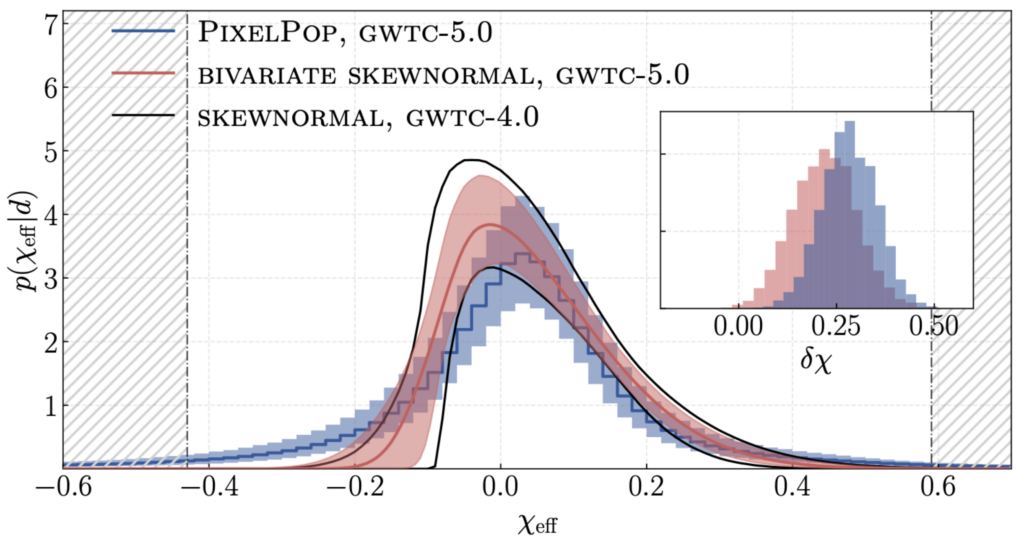
Figure 3 (adapted from Fig. 4 of our paper): Distribution of the effective spin parameter ( 𝛘eff ) of binary systems. The inset shows the asymmetry of this distribution, which can be particularly sensitive to how binary black holes form, for the two models we use in GWTC-5.
Digging into which black holes are rapidly spinning, we find that they occur at two distinct mass scales, as shown in Figure 4, with masses either in the approximate range 10-20 M or above 45 M. For these mass scales, such large spins are generally hard to explain within standard models of star formation. This suggests that alternate formation mechanisms such as hierarchical mergers (where black holes that formed from the merger of previous generations of black holes merge again) might be involved! This possibility would also be consistent with the recent LVK detections of GW241110 and GW241011, where both systems showed spin signatures that were consistent with hierarchical mergers. While this connection is very tantalizing, we cannot yet confidently rule out other possible mechanisms by which black holes with high spins might be produced.
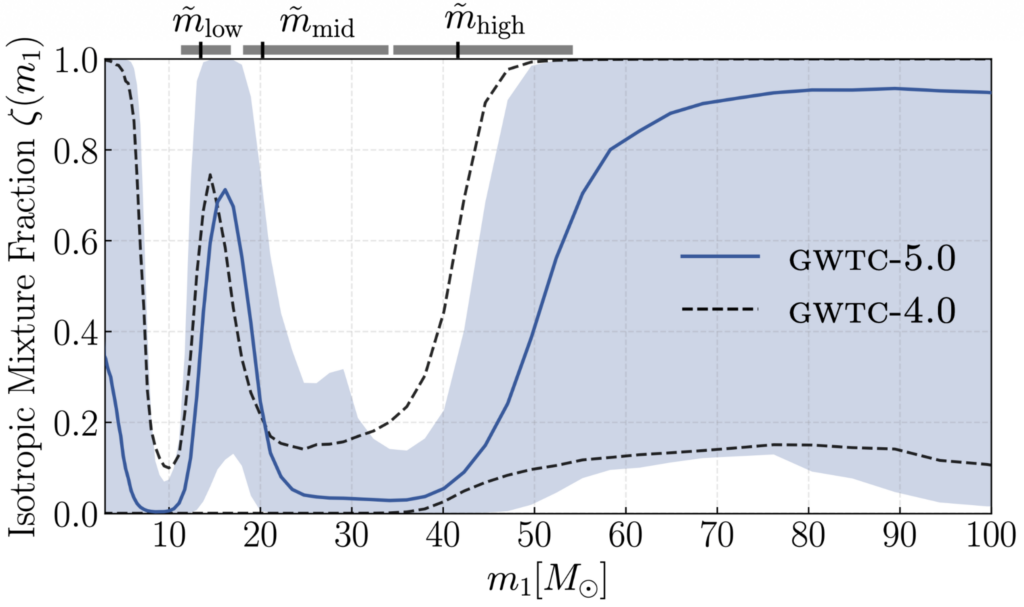
Figure 4 (adapted from Fig. 10 of our paper): The fraction of systems with a rapidly-spinning black hole as a function of mass. Black holes with rapid spins either seem to have masses in the approximate range 10-20 Mor above 45 M. The solid blue line shows the median fraction inferred from GWTC-5.0 and the shaded blue region shows the corresponding 90% credible interval for this fraction.
Conclusions
The new set of gravitational-wave detections in GWTC-5.0 provides our deepest dive yet into the population distribution of merging black holes and neutron stars. Several fascinating features in these distributions have crystallized clearly in this analysis, including the presence of black holes with high spins. All in all, this data set provides the clearest evidence yet that binary black holes may form in several different ways. The final update based on O4 data, GWTC-6.0 that is expected in a few months, will shed more light on these exciting new discoveries.
Find out more:
- Visit our websites:
- Read a free preprint of the full scientific article here:
https://dcc.ligo.org/LIGO-P2600045/public/ - Additional papers presenting GWTC-5.0:
- Introductory paper: https://dcc.ligo.org/LIGO-P2500701/public/
- Methods paper: https://dcc.ligo.org/LIGO-P2600166/public/
- Results paper: https://dcc.ligo.org/LIGO-P2600152/public/
- Gravitational-Wave Open Science Centre data release forGWTC-5.0:
https://gwosc.org/GWTC-5.0/.
Back to the overview of science summaries.