
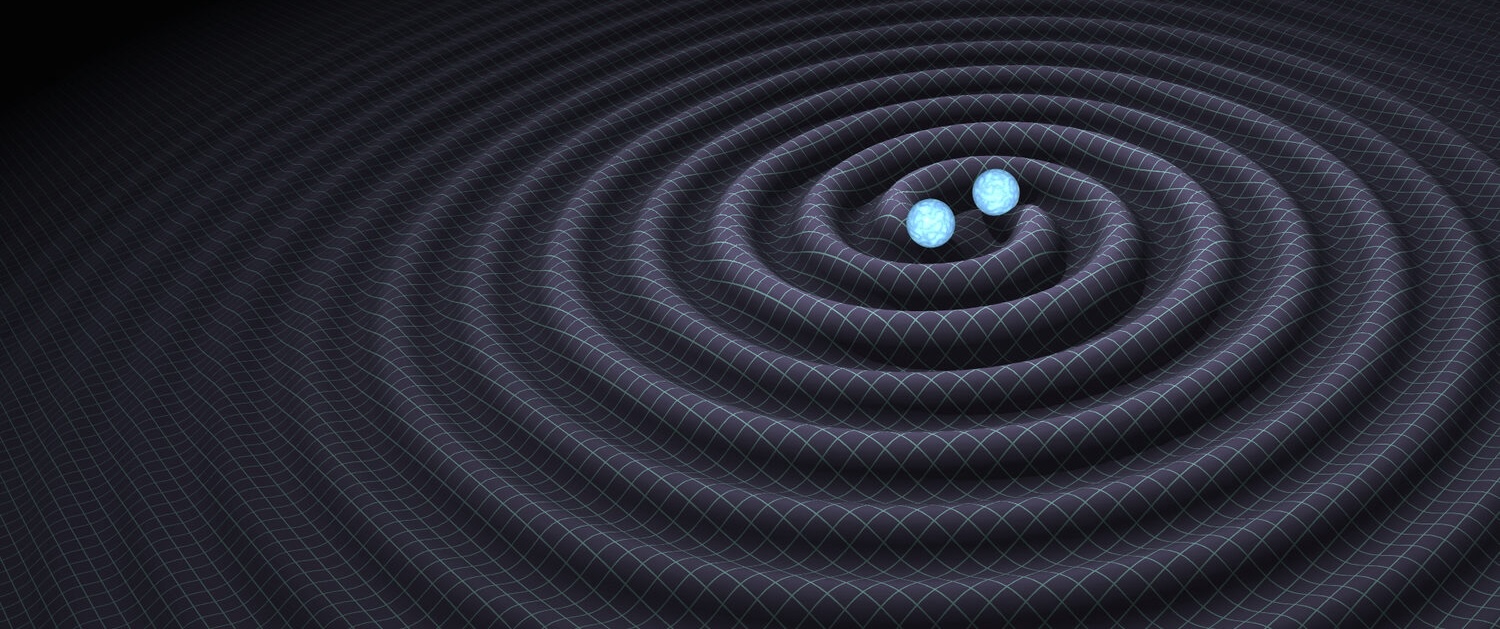
The LIGO-Virgo-KAGRA (LVK) Collaboration continued its search for mergers of objects lighter than the Sun (henceforth, “sub-solar mass”) using data from our gravitational-wave (GW) detectors collected during the second part of the LVK’s fourth observing run (O4b). The existence of these objects is the subject of much debate, as stellar evolution theories do not predict such low-mass objects. Conversely, dark matter theories dark matter predict the existence of objects within a range that spans multiple orders of magnitude in mass, including the sub-solar mass region. While we did not detect any sub-solar mass mergers in O4b data, nor in any of our previous searches, in O4b we have surveyed the Universe with the most sensitive GW detector network yet. Our latest search places the most stringent constraints to date on the merger rates of sub-solar mass objects, as well as the fraction of dark matter in certain dark matter models.
Over the past 10 years, the LVK Collaboration has identified more than 390 GW signals from merging compact-object binaries. The sources found so far have all come from black holes or neutron stars with component masses greater than the mass of the Sun.At the same time, our LVK detectors are also sensitive to GW signals from binary mergers with components that are lighter than 1 solar mass (1 M⊙), which are referred to as “sub-solar mass” objects. Compact objects lighter than the Sun would be unusual products of stellar evolution, although several formation mechanisms have been proposed and possible candidates have been reported. GWs from mergers of these light objects are not as powerful as those from mergers of more massive objects, making it challenging to detect these signals. Detections of such binaries would be highly significant and could provide new insights into compact-object formation and fundamental physics. Therefore, we carry out searches for signals from binary merger systems with at least one sub-solar mass component.
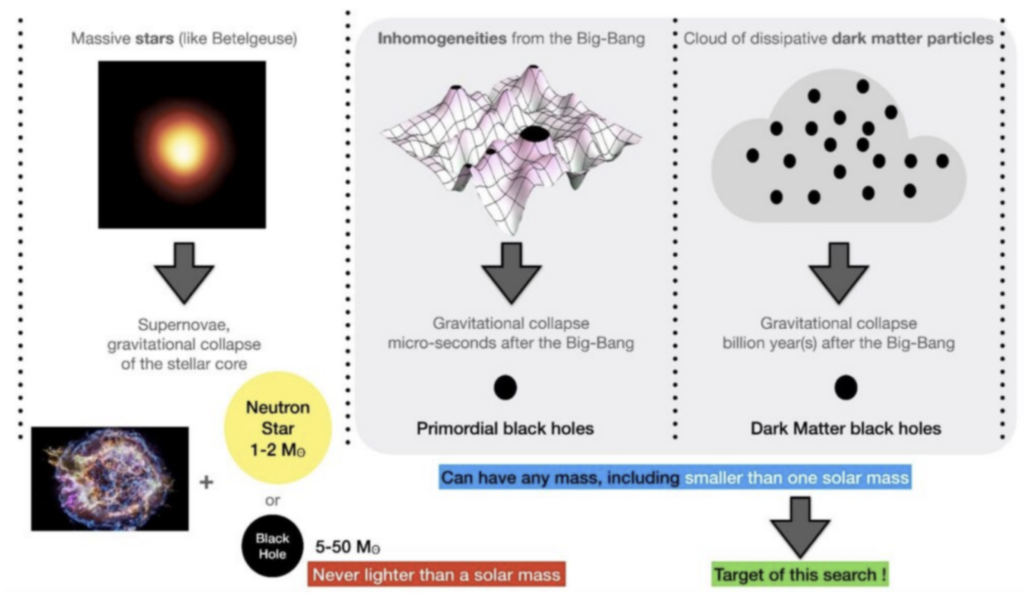
Figure 1: Diagram showing possible formation pathways for compact objects that can be detected by the LVK collaboration. Standard stellar evolution produces neutron stars and black holes, but is not expected to produce black holes lighter than the Sun. In contrast, other hypothetical mechanisms could form sub-solar mass black holes, including primordial black holes produced in the early Universe and black holes formed in some (so-called) dissipative dark matter model.
The fourth observing run of the LVK is split into three parts. Previously, we presented results for searches of gravitational-wave signals from binary mergers with at least one sub-solar mass object from the first part of O4 (O4a: May 2023 to January 2024). In the second part of O4 (O4b: April 2024 to January 2025) we continued to search for these signals, and we present the latest results here. While the two LIGO detectors, LIGO Livingston and LIGO Hanford, collected data in O4a, the Virgo detector joined for O4b, and the three detectors operated at their highest sensitivity ever. Analyses of the data from the third part of O4 (O4c: January 2025 to November 2025) are ongoing.
Searching for gravitational-wave signals in noise-dominated data is a challenging task. We analysed the data using three independent search pipelines (GstLAL, MBTA, PyCBC) to help us test whether a feature in the data is a real signal or an artifact of a particular analysis. These pipelines compare the detector data with precomputed GW waveforms, identify portions of the data that closely match those patterns, and estimate the statistical significance of these portions of the data. The search covered binaries in which the lighter object had a mass between 0.2 and 1 M⊙, while the heavier object could have a mass of up to about 11 M⊙. The simulated waveforms also included a wide range of possible spins. These choices are inherited from previous LVK sub-solar mass searches for consistency.
While we have not made any detections, GstLAL and MBTA each found one candidate that initially stood out from the detector noise. However, detailed follow-up showed that both candidates were more likely to be noise fluctuations than real astrophysical signals.
To measure how effective the search was, we added millions of simulated GW signals to the real detector data and tested which were recovered by the pipelines. This allowed us to estimate which systems the search could have detected and at what distances, i.e., the sensitivity of the searches. Our results build on top of previous results. We combined the sensitivity estimates obtained using O4a data with that obtained using O4b data for sub-solar mass binary black hole systems, as well as sub-solar mass neutron star systems. Since we found no convincing signals, and because our sensitivity tests tell us how many signals we would expect to detect for a given merger rate, we can place upper limits on how frequently these mergers occur.
Our upper limits are shown, at the 90% confidence level, in Figure 2. For example, for systems with a chirp mass of 2 solar masses, the upper limit is 50-72 per cubic gigaparsec per year. We also tested the search’s sensitivity to binaries containing unusually light neutron stars. For the population model considered, we found that fewer than 249 such mergers can occur per cubic gigaparsec per year.
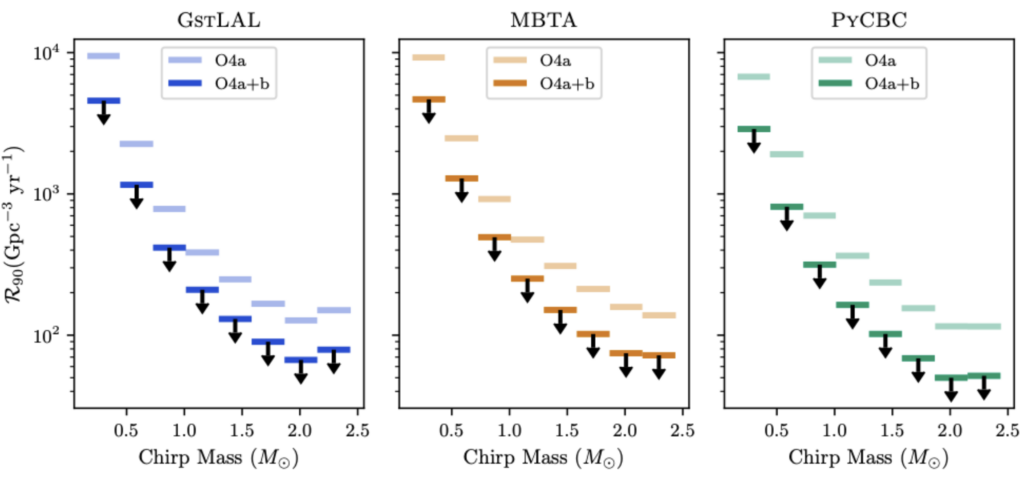
Figure 2: (Figure 7 in the paper.) 90% confidence upper limit (denoted as “R90” in units of per cubic gigaparsec per year) on the merger rate for a binary black hole population with at least one sub-solar mass component as a function of chirp mass. Results from O4a and O4b are combined to obtain the combined merger rate estimate, which is denoted by “O4a+b”. The dark (light) lines in each of the three subfigures represent the results for the O4a+b (O4a only) analysis. Arrows point in the direction of the possible merger rate not constrained by the O4a+b search.
These merger rate upper limits are used to place constraints on models of dark matter that predict sub-solar mass binary black hole mergers. We explore two different dark matter models: primordial black holes and dissipative dark matter black holes. Primordial black holes may have formed from dense regions in the early Universe. Some of them could later have formed binary systems and eventually merged. The dissipative dark matter model considers the possibility that dark matter is composed of particles, currently of unknown origin, that can interact with their surroundings , accumulate, and consequently undergo gravitational collapse to form black holes that later merge together. Using the upper limits on the merger rate of these objects obtained from our GW observations, we derive the maximum values for the fraction of dark matter density that can be in the form of primordial black holes and dissipative dark matter black holes, in the sub-solar mass range.
Assuming that all primordial black holes have the same mass, we constrain the dark matter fraction to be less than 1.8-3.2 % for black holes of 1 M⊙ or less than 10-15 % for black holes of 0.35 M⊙. For the dissipative dark matter model, we constrain the fraction of dark matter for a range of minimum dark matter black hole masses, to be as low as 0.001%. Combining O4a and O4b gives the strongest GW constraints to date for these models in the mass range explored by the sub-solar mass search.
O4c continued until November 2025. Analysing these additional data will provide another opportunity either to detect a sub-solar-mass merger or to place even tighter constraints on these populations. Stay tuned!
Find out more
- Visit our websites:
Back to the overview of science summaries.