
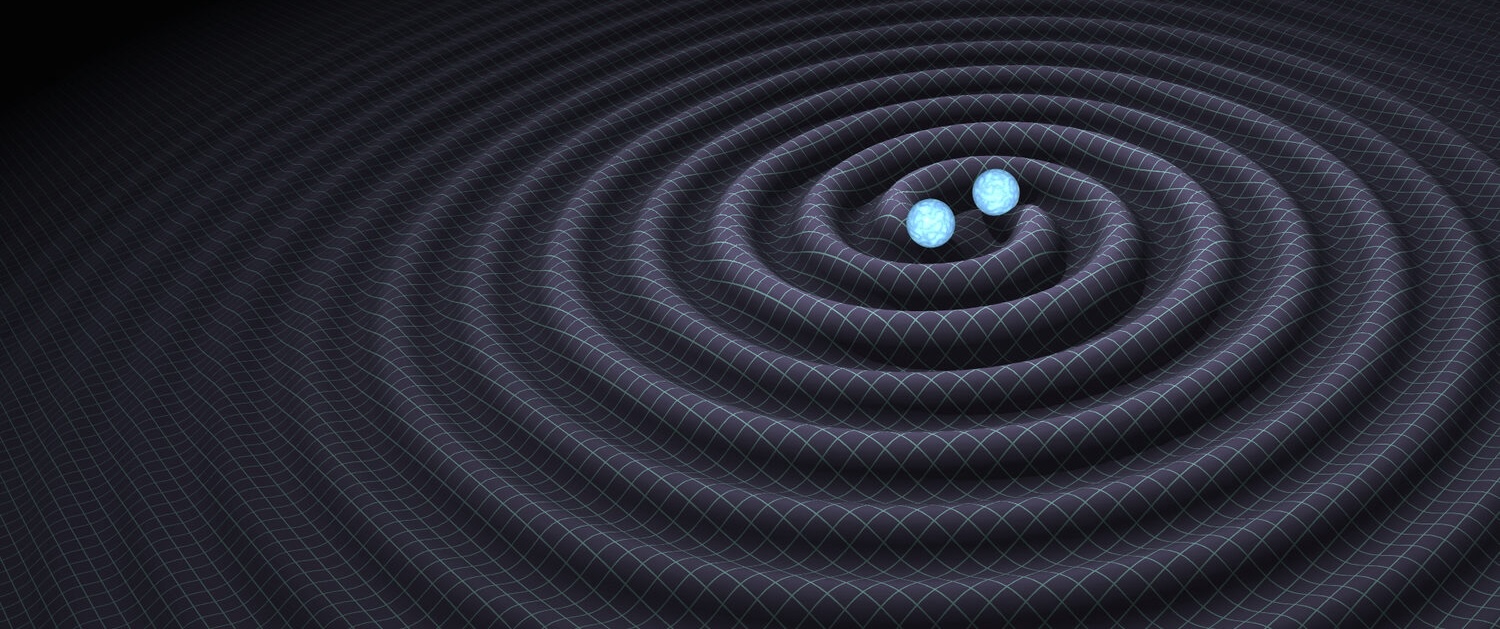
In July 2026, the LIGO-Virgo-KAGRA (LVK) collaboration published its latest results on testing General Relativity using gravitational wave (GW) signals from merging compact objects such as neutron stars and black holes. Combining 77 new high-significance signals from the fourth observing run — 72 from its second part (O4b) and 5 from the first (O4a) — with 91 events tested previously, this is the largest and highest-quality dataset ever used to test Einstein’s theory. Across every test, General Relativity passes once again, and the bounds on possible deviations are now significantly tighter than before.
(please visit our glossary for definitions of some technical terms: https://ligo.org/glossary/)
Einstein’s theory of General Relativity is currently the accepted theory of gravity. In the 111 years since Einstein introduced it, the theory has been thoroughly tested in many ways, always passing with flying colors. Yet, it remains under constant scrutiny: any observed deviation, however small, could provide clues to new physics beyond Einstein’s theory, such as a quantum theory of gravity or to the nature of dark energy. GWs are a direct prediction of General Relativity, confirmed by the first direct observation of two merging black holes in September 2015. Observations of the inspiral and merger of stellar-mass black holes provide a unique opportunity to check whether General Relativity still holds where gravity is at its strongest and most rapidly changing.
Over the last decade, the LVK collaboration has routinely used GW observations to test General Relativity. These tests have confirmed that any deviations from General Relativity, if they exist at all, must be very small—below the detectors’ measurement capabilities. As more GW events are observed, our tests become increasingly stringent. We now report results from 72 new high-significance signals from merging black holes in the second part of the latest observing run (O4b), plus 5 additional signals from the first part (O4a) that had not been analyzed before. Added to the 91 events tested in earlier observations, this gives us the largest dataset ever used to test General Relativity. This dataset is also exceptional in quality: it includes an unprecedented number of signals observed with remarkable signal-to-noise ratio, whose clear waveforms make new tests possible and sharpen existing ones. The standout event is GW250114, the loudest GW signal ever observed. Across every test, General Relativity passes once again, and the bounds on possible deviations are now significantly tighter. (See the previous science summary for the results of tests based on data up to O4a).
How do we test General Relativity? Einstein’s theory provides a well-established framework for describing gravity, and in recent decades great progress has been made in accurately modelling GWs from compact-binary mergers. The tests of General Relativity are based on either (i) assessing the internal consistency of the theory across different stages of the coalescence (see Figure 1), or (ii) searching for specific “distortions” of GW signals motivated by plausible violations of General Relativity.
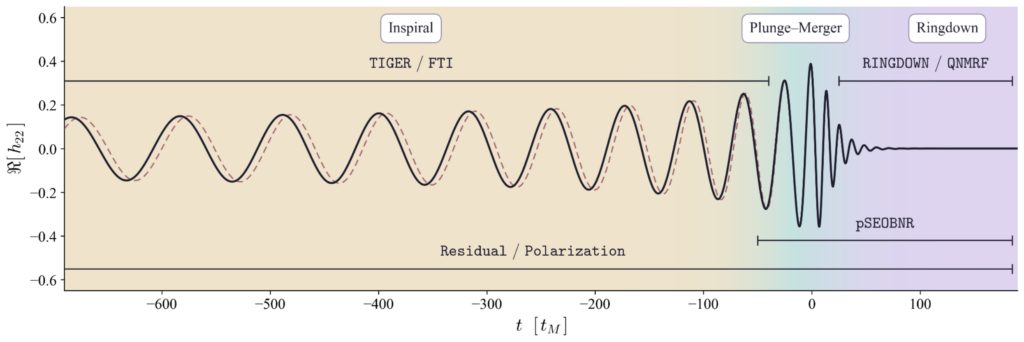
Figure 1: Schematic of a GW signal from a binary black-hole merger. The horizontal axis is time, and the vertical axis tracks the wave’s oscillation. The signal is split into three regions, inspiral, plunge-merger, and ringdown, each probed by a different set of tests of General Relativity. The brackets show the names of the tests and the part of the signal each one probes. A hypothetical signal that deviates from the General Relativity prediction is overlaid as a dashed line.
Possible deviations from General Relativity could arise during the generation of GWs, during their propagation, or because the merging objects are not the black holes described by General Relativity. These tests must be interpreted with care, however: fluctuations in instrumental noise, as well as limitations in the accuracy of the signal models used in the analysis, can mimic apparent deviations from General Relativity and must be carefully disentangled from genuine physical effects.
A multitude of tests
The large number and high quality of available GW observations allow LVK scientists to perform a wide variety of tests of General Relativity.
The most general check is to verify the overall consistency of the observed GW signals with the predictions of General Relativity. This can be done by subtracting the best-fitting signal predicted by General Relativity from the data and analyzing the difference, known as the residuals, comparing them against the expected instrumental noise. Since the observations we consider are made with at least two and sometimes three detectors, the consistency of the residuals across detectors—accounting for the light travel time between sites—provides an additional check: a genuine GW signal should appear as a correlated component across detectors, whereas the instrumental noise in each detector is uncorrelated.
A second class of tests examines the polarization content of the signal. Similar to light waves, GWs in General Relativity have only two transverse polarizations, called “plus” and “cross.” Alternative theories of gravity, however, can have up to six independent polarization modes. Polarization tests check whether the data are consistent with only the two modes predicted by General Relativity, or whether the gravitational field oscillates in a more general way. The presence of additional polarization modes can be tested using observations from multiple detectors. (See Fig. 5 of this summary to find out more.)
Other tests focus directly on whether the evolution of black hole binary systems, and the emission and propagation of GWs, deviate from Einstein’s predictions. Tests of propagation ask whether the waves arrive at our detectors unchanged after their long journey across the universe. For example, General Relativity predicts that GWs travel at the speed of light and interact very weakly with matter. In contrast, some alternative theories of gravity (such as those involving a massive graviton or dark energy) suggest that GWs may propagate at different speeds and experience dispersion. This would mean that different frequencies arrive at slightly different times, similar to how radio waves disperse when traveling through a plasma. Tests of the generation of GWs probe whether the way binaries inspiral and merge agrees with what General Relativity predicts. This can be tested by introducing additional parameters into the signal model that mimic the effects of alternative theories. If the data suggest that these parameters are consistent with zero, Einstein’s theory passes the test. Otherwise, the result may hint at new physics beyond General Relativity.
Finally, a set of tests focuses on the final black hole left behind by the merger. Initially distorted by the violent dynamics of the coalescence, the remnant emits GWs like a struck bell releasing its vibrations as sound, and this phase is known as the “ringdown”. These waves are radiated at specific frequencies and decay over characteristic timescales, both determined by the final mass and spin of the remnant black hole. This is the basis of the “no-hair theorem”: all distortions of the black hole —or “hairs”—are radiated away, leaving behind a final state described solely by two parameters. Much like a choir fading out at the end of a song, the black hole’s individual “voices”—the harmonic components of the ringdown—carry detailed information about their source. Scientists can therefore learn about a black hole’s mass and spin by analyzing its ringdown frequency spectrum and decay time. Detecting a single harmonic —which is usually the case— allows for consistency checks with parameters inferred before and during the merger, while resolving more than one harmonic and checking the consistency of the black hole parameters inferred from each provides a direct test of the no-hair theorem.
Is Einstein correct, then?
For every event considered, we find that the residuals are consistent with noise, indicating that the GW signals are well described by General Relativity.
We find no indication of additional polarization modes beyond the two predicted by Einstein’s theory, and no evidence for deviations from General Relativity in the generation of GWs. However, the present analysis places significantly tighter bounds on possible deviations than before, as illustrated in Figure 2 below.
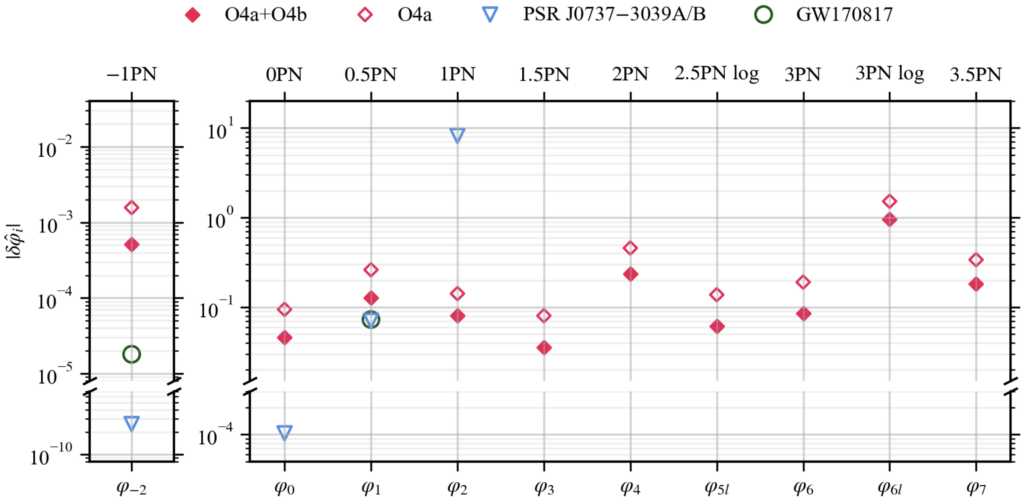
Figure 2: Constraints on the so-called post-Newtonian coefficients, which govern the phase of the GW signal. The horizontal axis lists the coefficients, ordered by the stage of binary evolution at which they enter the signal, from wide separations on the left to the late inspiral just before merger on the right. The vertical axis is the size of the allowed deviation, with lower markers meaning tighter constraints. The current analysis (filled red diamonds) yields significantly tighter bounds than the previous result (open red diamonds). For the lowest-order coefficients, bounds from the double pulsar PSR J0737−3039A/B (blue triangles) and the binary-neutron-star merger GW170817 (green circles) are shown for comparison.
We also performed dedicated analyses of the ringdown, the final vibrations of the newly formed black hole. In every case the measured frequencies and decay times remain consistent with those predicted for black holes in General Relativity, and the remnant masses and spins inferred from the ringdown agree with those estimated from the rest of the signal.
The latest detections do more than enlarge the sample: some of them make qualitatively new tests possible. The most striking is GW250114, the loudest GW event observed to date, which enabled the most precise constraints on deviations in the ringdown (see also these previous science summaries [1] [2]). For both GW250114 and GW240621, the ringdown analysis identified a subdominant harmonic alongside the dominant one, as illustrated in Figure 3 below, consistent with the vibrations expected from the black holes of General Relativity. GW241011, the signal from a binary in which one black hole is much heavier than the other and rapidly spinning, is unlike most systems observed so far, and provides strong constraints on potential modifications to the inspiral. GW240925, one of the loudest events, was recorded while a detector was affected by calibration uncertainties, and could be included only by inferring the instrumental calibration jointly with the properties of the source – an important check, since calibration errors could otherwise be mistaken for deviations from General Relativity.
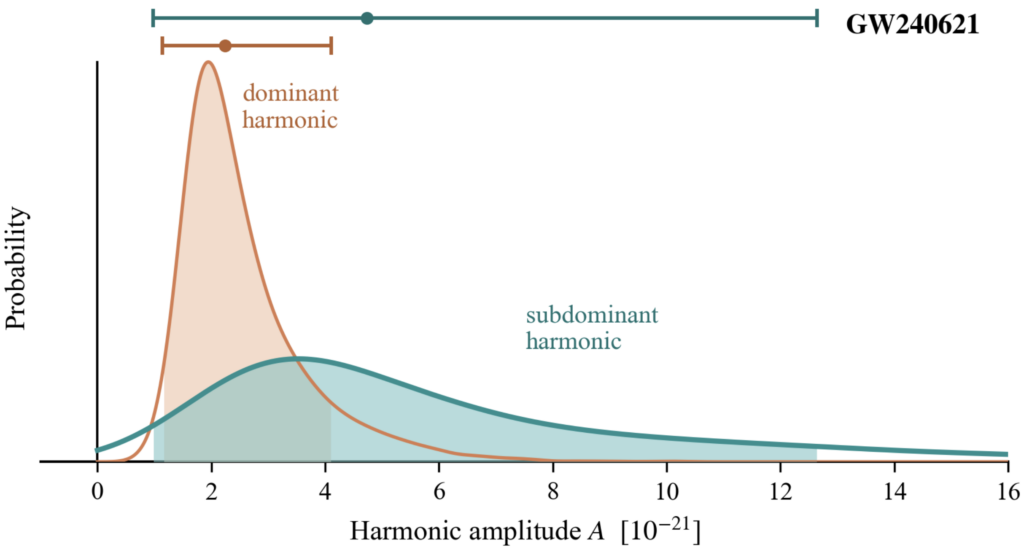
Figure 3: Probability distributions for the amplitudes of the dominant (orange) and subdominant (teal) ringdown harmonics of GW240621, jointly measured a short time after the merger (about 1.5 milliseconds, or roughly two times the time it takes light to travel across a distance comparable to the final black hole’s size). The horizontal axis is the amplitude in units of 10^-21, the typical scale of the GWs at our detectors. The shaded bands mark each harmonic’s 90% credible region, the narrowest range containing 90% of the probability. The markers above the curves summarise the same range together with the median amplitude (filled dot) for each harmonic. Both regions exclude zero, indicating that the subdominant harmonic is confidently measured alongside the dominant one. The subdominant harmonic decays much faster than the dominant one, so although its amplitude can briefly equal or exceed that of the dominant harmonic at this early time, it fades away rapidly while the dominant harmonic lingers on.
Overall, these results confirm that General Relativity remains consistent with GW observations, without requiring modifications or new physics. Furthermore, by combining the 77 newly tested events with earlier detections, we have placed even tighter constraints on possible deviations from General Relativity. As the LIGO-Virgo-KAGRA detectors continue to improve, the next observing runs are expected to deliver even louder signals, and even sharper tests of Einstein’s theory.
Find out more
- Visit our websites:
- Read a free preprint of the full scientific article:
“GWTC-5.0: Tests of General Relativity”
https://dcc.ligo.org/LIGO-P2500781/public/ or on Arxiv: https://arxiv.org/abs/2607.19293 - Gravitational-Wave Open Science Centre data release for GWTC-5.0:
https://gwosc.org/GWTC-5.0/
Back to the overview of science summaries.